

5.3. Combinatorial Reaction
ADMET Predictor can be used to generate the virtual products of a combinatorial reaction specified by you. For example, you can provide ADMET Predictor with a number (m) of carboxylic acids and a number (n) of amines, and generate the (m×n) amides resulting from the typical amide-forming condensation reaction. Reactions can be specified using Daylight SMIRKS format or MDL rxnfile format, or can be pasted directly from MedChem Designer. The lists of reactants are read from external SD, SMILES or CTK files.
DESIGN >>Combinatorial Reaction opens the Perform reaction dialog as shown below:
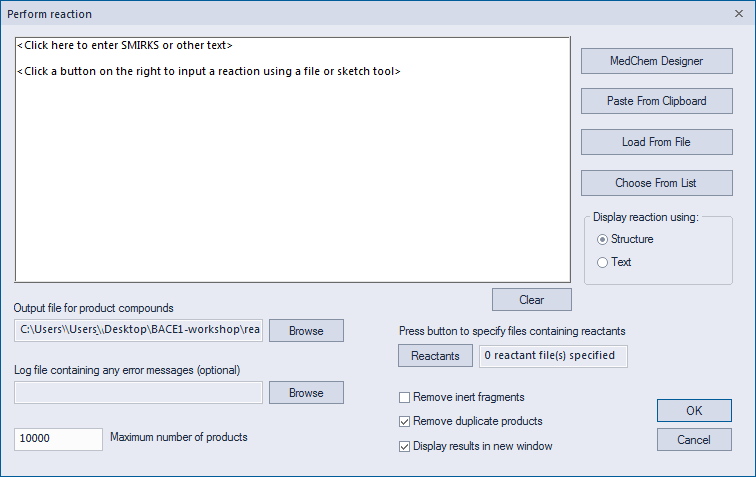
To specify reactants, click the Reactants button and specify the relevant files on the subsequent helper dialog.
The easiest way to input a reaction is to draw it using MedChem Designer. Simply click the MedChem Designer button, draw the reaction, then transfer it back to the dialog; consult the MedChem Designer manual for details.
ADMET Predictor also supports the SMIRKS reaction language developed by Daylight CIS, Inc. That company’s website (www.daylight.com) provides an excellent tutorial for the SMIRKS language, so details of the syntax will not be provided here. Note that ADMET Predictor’s enhancements to the SMARTS query language are also incorporated into the SMIRKS engine; see the Query Formats section for complete details.
Note also that any limitations in ADMET Predictor’s support of SMARTS queries also affect SMIRKS support. The most significant example is the SMARTS “wild card” atom query, denoted by an asterisk (*). The Daylight interpretation of this symbol is “any atom, including Hydrogen.” By contrast, ADMET Predictor interprets the symbol as “any atom, excluding Hydrogen.” This distinction can have a dramatic effect on how SMIRKS strings are processed during reactions.
The following are example SMIRKS reactions; see www.daylight.com for a complete tutorial.
[O:1]>>[S:1] Oxygen to Sulfur
[C:1](=[O:2])[OH].[NH2:3][C:4]>>[C:1](=[O:2])[NH:3][C:4] Amide formation