

6. HTPK Simulation Module
Unlike most ADMET predictions in Predictor, those generated by the HTPK Simulation Module are mechanistic rather than statistical in nature. Estimates of fraction absorbed in the intestinal tract (%Fa), relative oral bioavailability (%Fb) and the dose required to produce a given steady-state plasma concentration (OptDose) are the result of High-Throughput PharmacoKinetics (HTPK) simulations. Predictor uses ADMET property estimates and doses provided as input to set up and solve a deterministic system of differential equations parameterized with respect to a predefined human, rat, mouse, dog or monkey physiology.
Simulations include the stomach and eight intestinal compartments from the Advanced Compartmental Absorption and Transit (ACAT) pharmacokinetic analysis system used by GastroPlus®. They take dissolution, permeation, transit, and variation in physicochemical conditions (e.g., pH) along the digestive tract into account, as well as a liver compartment included for estimating first-pass metabolism and oral bioavailability (%Fb). The general circulation and other organs are lumped into a single "Central" compartment, but the variation in composition between tissues is factored in when calculating the effective volume of that central compartment - i.e., the mechanistic volume of distribution (S+hVd_PBPK, S+rVd_PBPK, S+mVd_PBPK, S+dVd_PBPK and S+mkyVd_PBPK for humans, rats, mice, dogs and monkeys respectively).
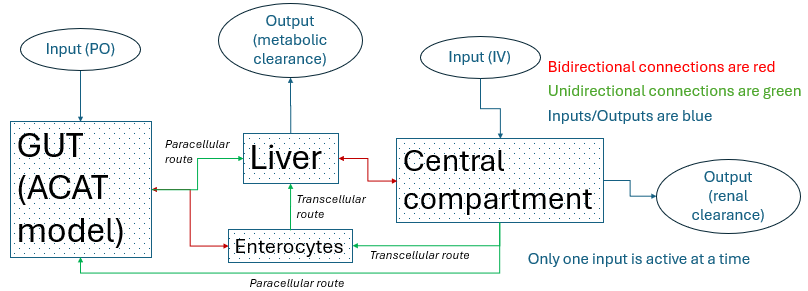
The user interface for the HTPK Simulation Module has been kept as simple as possible to streamline the simulation process - hence the "high-throughput" in the module name. It is designed to help medicinal chemists quickly estimate intestinal absorption and bioavailability for libraries of synthesis or acquisition candidates, so only parameters likely to vary from run to run are set in the top-level dialogs. Those that may need to be changed occasionally are accessible through the Advanced simulation parameters dialog. All simulation settings are stored in HIA files in your applications data directory, including several that should only be changed in consultation with someone familiar with pharmacokinetic simulations.
Care is taken to account for cases where low solubility or permeability of a compound limit absorption or high first-pass metabolism compromises bioavailability. Both are problems often encountered early in development. Some potentially important pharmacological effects are not considered, however, in part because they are difficult or impossible to predict early in development and in part because they can slow down the simulation. In particular, there are no provisions for non-linear transporter or metabolism kinetics. For more details on the scope and limitations of the program, please see the Simulation Theory section.