

6.2. Dose Optimization
The HTPK Simulation Module allows you to carry out HTPK simulations using our proprietary ACAT model to predict the dose required to achieve a specified target plasma concentration. OptDose is the oral dose that, when repeated periodically, will sustain the desired plasma concentration at an effective concentration (Ceff). This is the "steady state," where administration of an additional dose does not increase the “peak and trough” plasma concentrations.
TOOLS >> PK Simulations >> Dose Estimation or clicking on the capsule icon in the main toolbar launches the Estimate dose needed to reach target concentration dialog.

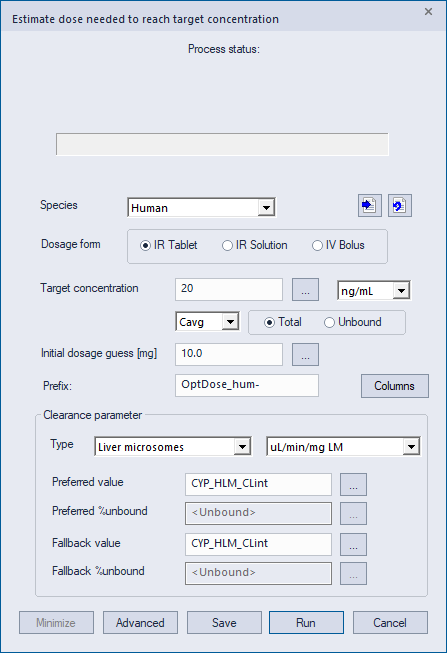
The program supports five Species: Human, Rat, Mouse, Dog and Monkey. You can only run simulations for one species at a time.
The Dosage form can be either IR Tablet (immediate-release tablet), IR Solution or IV Bolus.
The Target Concentration is the desired plasma concentration at steady-state. You can supply a numeric value, as in the figure above, or you can enter an attribute name present in the spreadsheet. ADMET Predictor lets you choose between two units for the target concentration: ng/mL or μM. The target concentration can be an average (Cavg; shown above), minimum (Cmin) or maximum (Cmax), and can represent either a total (bound plus unbound; shown above) or unbound concentration. Note that conversion between total and unbound concentration uses the specified value of the “Unbound in plasma [%]” option on the Advanced dialog.
The Initial dosage guess gives a place for the dose optimization to start from. Sometimes the program will not be able to achieve the desired Ceff from a particular starting dose, e.g., because of simulation complications due to precipitation or a large volume of distribution. When that happens, choosing a different Initial dosage guess (typically a lower one, but not always) may solve the problem.
Prefix specifies the name to give the output attribute. OptDose_xyz is supplied as a default, with xyz depending on which Species is selected. If you choose to modify the prefix value, we strongly recommend that you retain the "OptDose_xyz" portion at the beginning. For example, you could use "OptDose_hum_run1-" by inserting "_run1" just before the terminal hyphen. This format will ensure that all result properties have consistent naming.
The remaining dialog items behave just as described for their counterparts in the Simulate fraction absorbed and bioavailable dialog.
After running the simulation, a number of new columns are added to the ADMET Predictor spreadsheet. Aside from the optimal dose itself, most of the other parameters are described in the section on absorption and bioavailability. The columns are listed below. For brevity, species and dose suffixes have been removed. If you wish to omit one or more of these columns, you can do so by clicking the Columns button and selecting the ones you would like to save and display.
OptDose. The simulated optimal dose in mg, capped at 1000 mg.
Opt%Fa. Fraction absorbed in selected species at optimized dose level. This value is computed using only the first dosing interval.
Opt%Fb. Fraction bioavailable in selected species at optimized dose level. This value is computed using only the first dosing interval.
CminSS. Minimum plasma concentration (ng/mL) reached in selected species at optimized dose level. Measured during final dosing interval.
CmaxSS. Maximum plasma concentration (ng/mL) reached in selected species at optimized dose level.
TmaxSS. Time (hr) relative to the last administered dose at which maximum plasma concentration is reached in selected species at optimized dose level.
AUCss. Area under the concentration-time curve (ng-hr/mL) for the final dosing interval in selected species at optimized dose level.
CLss. Total clearance (L/hr) at steady state in selected species at optimized dose level, calculated as bioavailability times dose divided by steady-state AUC.
THalf. Half life (hr) at steady state in selected species at optimized dose level, calculated from the ratio of volume of distribution to clearance.
DoseCountSS. Number of doses required to reach steady state at optimized dose level.
CLp_H. Estimated hepatic clearance (L/hr) in plasma. This is calculated using the hepatic clearance formula provided in the theory section.
CLp_HR. Estimated hepatic plus renal clearance (L/hr) in plasma. This is the sum of CLp_H and the passive renal clearance (GFR*fup).
fup_adj%. Lipid-adjusted percent unbound to plasma proteins.
Kp_[tis]. Partition coefficient for the specified tissue ([tis]) relative to plasma.
N_OutInp. The number of out-of-scope predictions used as inputs to the simulation.
OutInp. List of out-of-scope predictions used as inputs to the simulation.