

6.5. Advanced Simulation Parameters
The Advanced simulation parameters dialog is launched when you click on the Advanced button in the Simulate fraction absorbed and bioavailable dialog or in the Estimate dose needed to reach target concentration dialog. The Species setting corresponds to whichever was selected in the dialog from which it was launched.
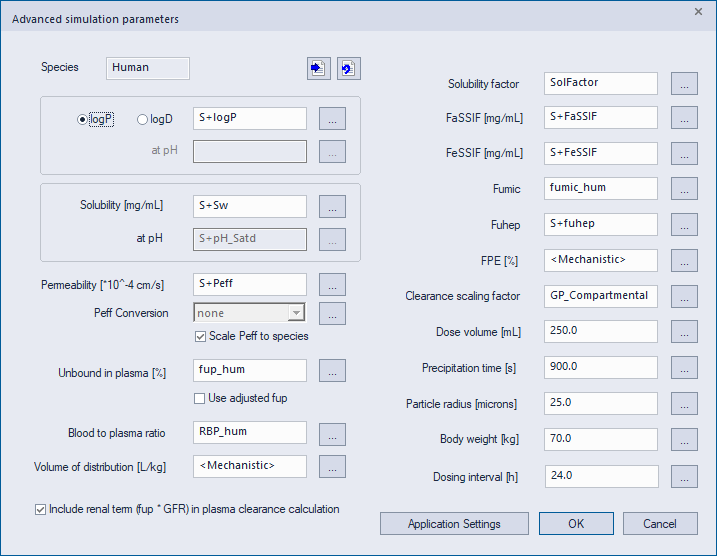
Several of the input parameters are briefly described below. As in the case of the parent dialogs described previously, predicted values from ADMET Predictor are used as the default values in most cases, and you can specify an existing spreadsheet attribute or a numeric value as an alternative.
logP is the common logarithm of the partition coefficient between water and n-octanol for neutral molecules. LogD is the common log of n-octanol/water distribution coefficient at a specified measurement pH, which must be supplied if the logD option is chosen. A typical at pH setting is 7.4.
Solubility [mg/mL] is the aqueous solubility in mg/mL at thermodynamic equilibrium. If the solubility was measured at a specific pH, the at pH value must be provided.
Permeability [*10^-4 cm/s] is the effective human jejunal permeability (Peff) in 10-4 cm/s.
Peff Conversion allows you to convert an experimental permeability value into a human jejunal permeability (Peff). Note that this control will be disabled if the Permeability is set to the default S+Peff model; to enable it you must select an available attribute or enter a value manually. See the Peff Conversion section for information about creating conversions. Note the the button with three dots to the right of the text box will launch the Permeability Converter dialog.
Scale Peff to species controls whether permeability is assumed to be a human value and will be adjusted to reflect the selected species. Note that scaling is performed automatically if the permeability is set to the ADMET Predictor model (S+Peff).
Unbound in Plasma [%] is the percent unbound in blood plasma.
Use adjusted fup controls whether the specified percent unbound value should be adjusted to account for non-specific binding to lipids and used in the well-stirred model to account for liver clearance. Note that this setting does not affect the mechanistic volume of distribution, which always uses the adjusted fup. Note also that renal clearance (fup*GFR) is always computed using the non-adjusted fup.
Blood to plasma ratio is the unitless ratio of blood to plasma.
Volume of distribution [L/kg] is the volume of distribution in L/kg. A value of <Mechanistic> triggers an internal calculation based on the Lukacova extension of the Rodgers approach. The variation in composition between tissues is factored in when calculating this mechanistic volume. Note that the mechanistic volume is returned as an output column, both in the Fa/Fb and dose-optimization workflows, regardless of whether or not <Mechanistic> is selected in the dialog.
Include renal term… controls whether a renal term will be added to the clearance calculation. If this option is on, the renal term is computed as fup*GFR; otherwise, no renal term is included. Note that GastroPlus compartmental simulations do not include a renal term.
Solubility factor is the ratio of salt solubility to the intrinsic solubility.
FaSSIF [mg/mL] is the solubility, in mg/mL, in simulated intestinal fluid in fasted state.
FeSSIF [mg/mL] is the solubility, in mg/mL, in simulated intestinal fluid in fed state.
Fumic is the fraction unbound in liver microsomes.
Fuhep is the fraction unbound in hepatocytes.
FPE [%] is the first-pass extraction in %. A value of <Mechanistic> triggers an internal calculation that uses clearance, body weight and blood to plasma ratio.
Clearance Scaling Factor is an additional user-defined value by which intrinsic clearance is multiplied. A value of 1 results in no additional scaling. If the value is "GP_Compartmental" (default), the scaling factor is set to an internal constant that reproduces the clearance scaling in the GastroPlus software when performing Compartmental simulations (as opposed to full PBPK). For example, GastroPlus assumes a liver weight of 1500 g for a 70 kg human, even though a value of 1820 g would be obtained from the default LiverToBodyRatio value of 0.026 (see ACAT.inp); hence the "GP_Compartmental" option sets the scaling factor to 1500/1820 for human. Note that this parameter is relevant only when intrinsic clearance is from liver microsomes or hepatocytes; it is ignored for systemic clearance.
Dose volume [mL] is the amount of water given with dose in mL.
Precipitation time [s] is the mean precipitation time in seconds.
Particle radius [microns] is the API particle radius in microns.
Body weight [kg] is the subject’s body weight in kg.
Dosing interval [h] represents the time between doses, in hours.
If you initiated HTPK simulation with a single row selected in the spreadsheet, two additional buttons will appear at the top center of the Advanced... dialog. These let you load the specified parameter values for the selected compound and modify them, if you wish. Please refer to the description of the parent dialog for details.