

4. MedChem Studio™
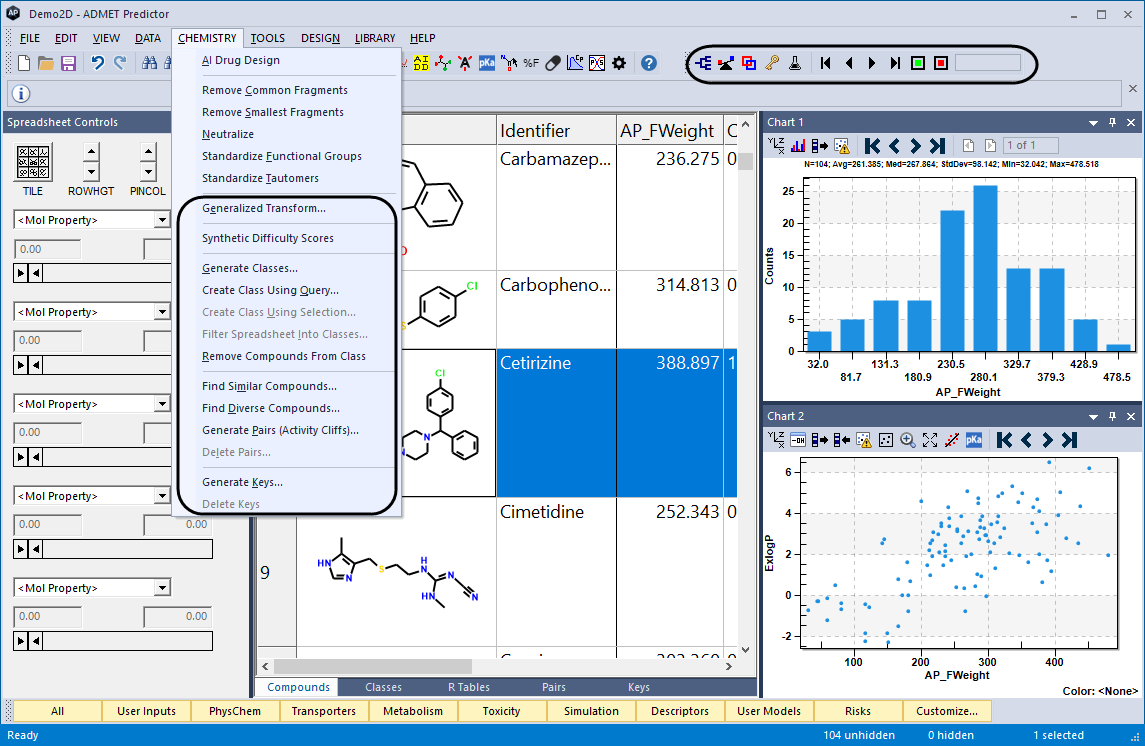
The newly introduced MedChem Studio™ module of ADMET Predictor offers a collection of specialized tools to assist chemists in decision making during the early discovery phase, from lead identification through lead optimization. Most of these tools were integrated from the separate MedChem Studio software application, and include the ability to cluster compounds by common scaffold, search by similarity, perform matched molecular pair analysis, design novel compounds, and much more. The MedChem Studio module makes available several new options within the user interface. The diagram below shows some of the new options that become available on the CHEMISTRY menu and the toolbar.
Classes
The class generation feature of ADMET Predictor allows you to cluster compounds into a small number of structural families, where each compound in a given family shares a common scaffold. Once classes have been generated, they can be visualized and further analyzed in the Classes tab.
R Tables
Generating R-group tables is a tedious task that medicinal chemists often perform repeatedly for every project. When you have a set of compounds that contain a common or similar scaffold, and different groups at one or more attachment points on the scaffold, R group analysis proves to be an important tool to analyze the set of compound properties as a function of the groups at the various attachment points. The MedChem Studio module in ADMET Predictor provides an excellent platform to automatically build these R-Tables from the compounds belonging to a single structural class. Another useful feature is the R Group Analyzer window, which allows you to visualize an R table as a series of “Ri versus Rj” matrices (e.g., R1 versus R2), with matrix rows and columns comprised of the observed Ri and Rj substituents, and the matrix interior comprised of color-coded information about the molecules containing those substituents. This type of display can be particularly useful for observing the effects of substituent changes on activity or other properties.
Molecular Pairs/Activity Cliffs
Occurrences of activity cliffs are important to synthetic chemists, as they indicate which small changes in molecular structure produce large changes in biological action, thus providing insights into which portions of a molecule should, or should not be modified. The MedChem Studio module in ADMET Predictor provides state-of-the-art technology not only to generate matched pair, but also to cluster them according to common structural change and to rank them according to significance.
Keys
The keys generated by ADMET Predictor constitute a special class of molecular descriptors that can usually be represented as substructure queries, i.e., they are a kind of substructural fingerprint. They have a number of uses, including SAR elucidation, model building, similarity/diversity analysis, and clustering. Once generated, keys can be visualized and analyzed in Keys tab.
Compound Design
The MedChem Studio module includes several features to generate novel compounds. These include transforming a lead compound using bioisosteric-substitution and other similar rules (Combinatorial Transforms); "filling in the gaps" in an existing R table (R-Table Explosion); and creating virtual combinatorial libraries using either a reaction combined with lists of reactants (Combinatorial Reactions), or a scaffold containing R groups combined with substituent lists (R-List Explosions). These methods are explained in Compound Design.
Molecular Libraries
ADMET Predictor allows you to convert structure files – such as SD and SMILES files – into local databases that can then be rapidly screened using a variety of different query types.