

7.8.2. Loading User Models
This data set was used to build a pIC50 model (-log(IC50) in units of M) with ADMET Modeler. The model is provided for you, but you still need to import it using Model Editor. You also need to import a Risk model to address the potential blood-brain barrier penetration issues discussed by Rombouts et al.
Launch Model Editor by clicking on its toolbar icon

Click on the Import models button.
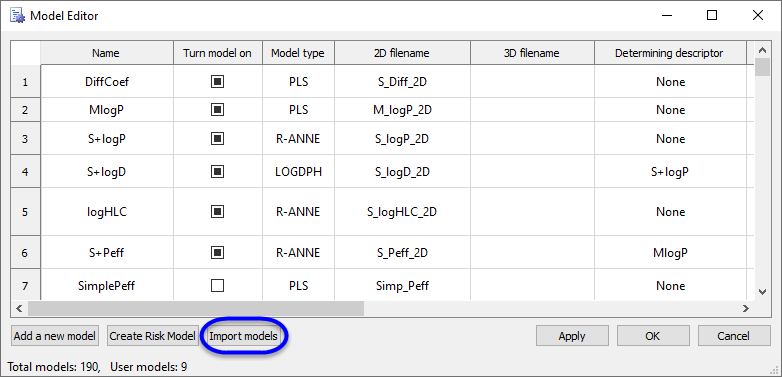
Browse to the same Tutorial/AIDD folder and select both BACE1_Model_settings.inp and BBB_Risk_settings.inp. Then, click Open.
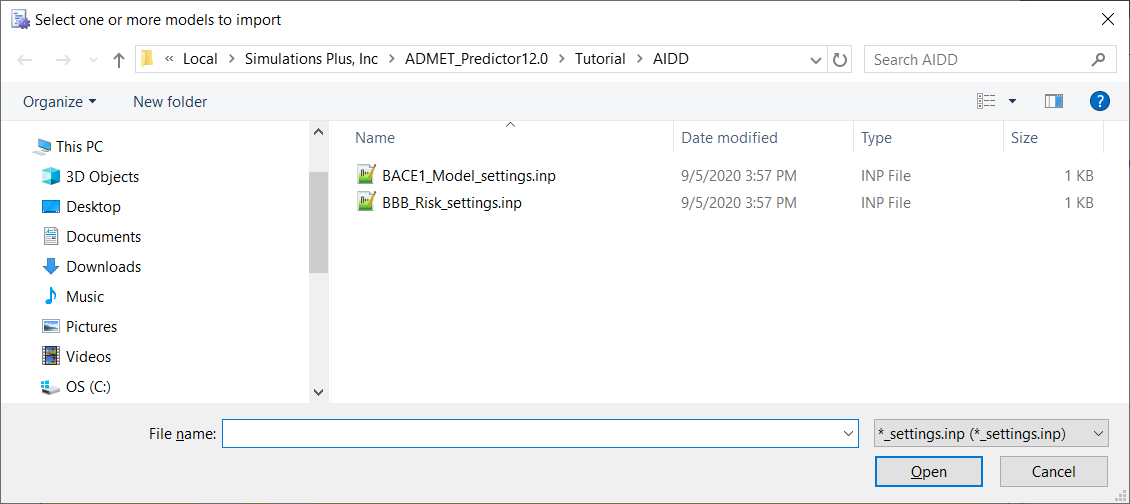
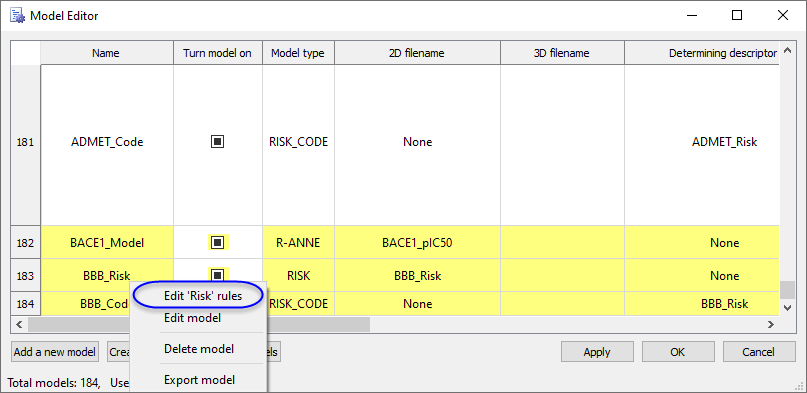
The two models get imported into the Model Editor and appended to the end of the model list. The BBB_Risk model consists of three rules. Right-clicking on the BBB_Risk cell and selecting Edit 'Risk' rules will launch the Risk Rule Editor so that you can see what they are.
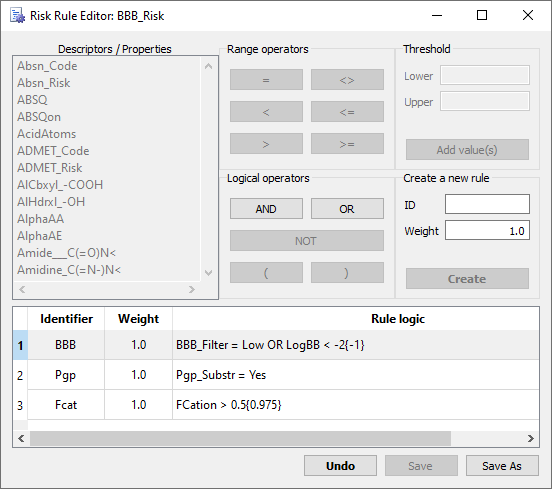
The BBB rule increments the BBB_Risk score by 1.0 if the BBB_Filter model predicts a compound to have Low penetration or if LogBB (the log of the brain/blood ratio) is predicted to be less than -2. The penalty for a low LogBB prediction decreases linearly to no additional Risk if the predicted value is -1 or greater (see the section on soft thresholds for a detailed discussion of how this works).
The Pgp rule increments the Risk score by 1.0 if the Pgp_Substr prediction is Yes.
Finally, as discussed in the Rombouts article, it is undesirable to have a molecule that is highly basic. Hence the Fcat rule increments the Risk score by 1.0 via a soft threshold on the fraction cationic descriptor (FCation), with the penalty starting at 0.5 (corresponding to a monoprotic basic pKa of 7.4) and ramping up to 1.0 when a value of 0.975 (corresponding to a monoprotic basic pKa of 9.0) is reached. FCation values above 0.975 receive a full Risk weight of 1.0.
After reviewing the rules, close the Risk Rule Editor, click OK to dismiss the Model Editor and load the models into ADMET Predictor.