

2.2. ADMET Risk™
ADMET Risk models and their companion ADMET Code models allow you to readily summarize the otherwise mind-numbing range of potential liabilities that can derail a drug candidate's development, from low solubility to unacceptably fast CYP metabolism to causing phospholipidosis. ADMET Predictor accomplishes this by comparing various predictions to a series of Risk rules, tallying up the number of rule violations encountered for each compound and presenting the resulting score (weighted by the seriousness of the violations) to you. Each Risk score is accompanied by a mnemonic Code list that indicates which rules were violated, e.g., "size" if the compound is too large to be absorbed passively in the gut. Risk scores and their companion Code columns are displayed side-by-side in ADMET Predictor, so one can see at a glance exactly what the predicted liabilities are for a given structure.
Several ADMET Predictor modules have a specific ADMET_Risk model for the descriptors and models included therein, in part to accommodate the fact that not everyone licenses all modules. The rules making up Absn_Risk, CYP_Risk and Tox_Risk are detailed in subsequent sections of this chapter. These focused Risk scores are useful, but the over-arching ADMET_Risk model that includes them all provides the most information. It incorporates the 20 rules that contribute to the other three Risk models as well as two more that touch on potential pharmacokinetic problems:
fu: fup_hum < [4,6] (low fraction unbound)
Vd: Vd > [4,5] (high steady-state volume of distribution)
Here, "fu" and "Vd" are mnemonic codes and the square brackets denote threshold ranges (see below).
ADMET_Risk exceeds 7 for 10% of a reference set of 2260 commercial drugs from the World Drug Index (WDI), so a few violations by any single compound are not necessarily cause for concern. You can create customized Risk models of your own that are tailored for your development program(s). We break out several submodels focused on specific properties: Absn_Risk, CYP_Risk, and TOX_Risk. The respective thresholds of concern with respect to our WDI reference set are 4, 2 and 2.
Risk Code columns provide a series of short codes (mnemonics) that indicate which ADMET Risk rules were triggered. Both columns are defined as predictive models in ModelProperties.inp under the FILTER and FILTER_CODE model types, respectively. See Adding a New Risk Model for details.
Accessing Risk Models
Risk models and their associated codes are calculated along with other ADMET properties by clicking on the ADME icon (1). Subsequently clicking on the Risks button (2) will focus in on the *Risks* and *Tox* star plots along with the various Risk scores and codes. RuleOf5 and MUT_Risk will also come up but have been undisplayed here to simplify the figure; they are discussed in detail below and in the Reproductive and Genetic Toxicity section, respectively.
Hovering over the green wedge in the *Tox* star plot for flucythrinate (3) pops up an indication that it represents overall ADMET_Risk and confirms the visual impression that it is high. The value is above 7, the threshold of concern indicated above, but this simply illustrates the importance of context for the scores' proper interpretation: flucythrinate is an insecticide and acaricide whose use is not currently approved in the United States. Were it to come up as a "hit" in a virtual screen for pharmaceutical applications, these results would discourage it being followed as a lead.
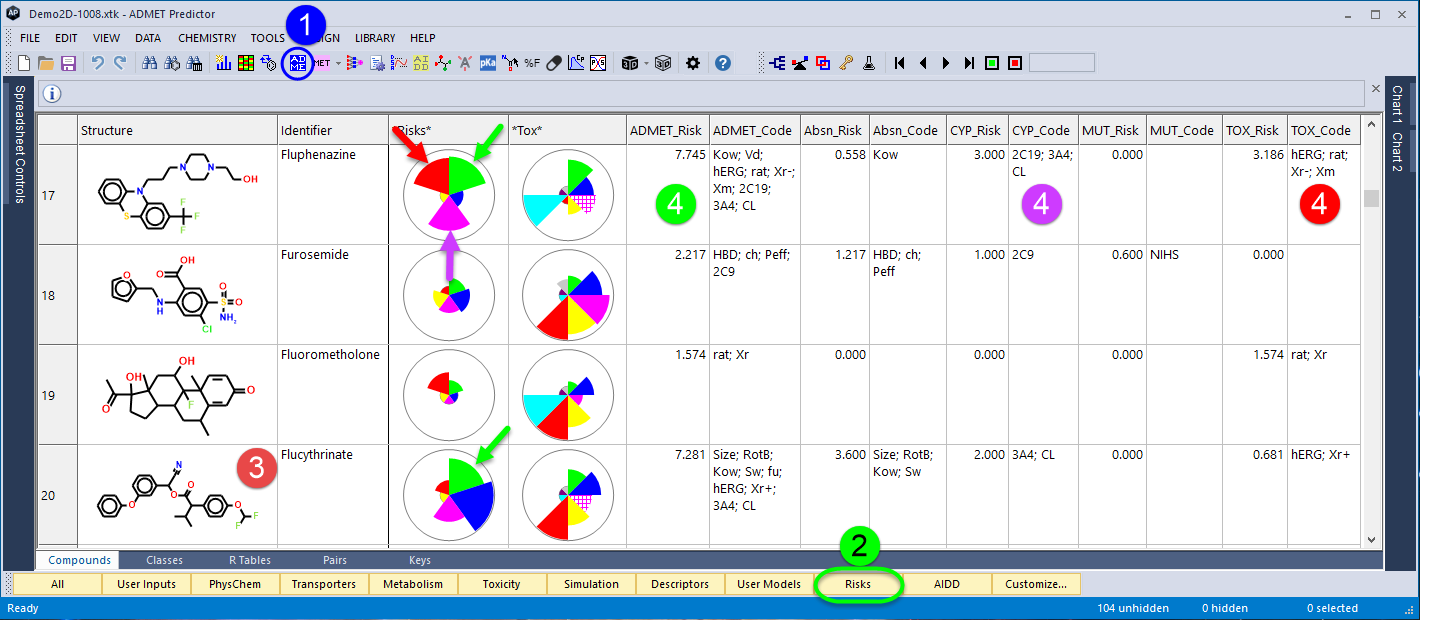
Examining the ADMET Code for compounds for which the Risk score is high is a good way to quickly focus in on predictions that represent potential liabilities, but triggering several Risk flags does not mean that a compound cannot be commercially successful as a drug. Fluphenazine is an example of this. Its high Risk scores may seem surprising, but the tight binding predicted for hERG (hERG_pIC50, represented by the green wedge in the *Tox* star plot) is borne out by experiment (Hong 2013). The Risk column entries indicate that the ADMET and Tox Risk scores are 7.7 and 3.2, respectively, both well above the 90% reference drug panel scores. The corresponding Codes (4) point out the specific rule violations underlying the high scores.
ADMET Risk models can be applied as "dumb" filters - e.g., discarding any compound that violates any rule - but it is wiser to take a more nuanced approach. This is in part because any predicted classification or value is uncertain to a greater or lesser degree, so there is a very real possibility of discarding a compound because it set off an in silico false alarm. It is always wise to check the associated confidence and/or uncertainty estimate(s).
Experimental values are always uncertain as well, but one can re-run the assay to confirm or refine that finding; the computational result, in contrast, will be the same every time. Predictions can also be out of scope for some models, which is indicated in the Code mnemonics by an appended "+" or "-" flag (e.g., Xr- for fluphenazine and Xr+ for flucythrinate. The somewhat complicated effect of out-of-scope predictions on Risk scores is discussed in detail elsewhere.
In assessing a group of analogs, the best approach is to look for structurally related series that tend to have low ADMET Risk scores and, preferably, a range of scores and codes. The models are not likely to be wrong when all compounds in a structural class are predicted to have the same problem and it is unlikely that tweaking the substitution pattern is likely to alleviate it.
Using in silico predictions and in vitro assays (many of which are themselves models for in vivo endpoints) together can be particularly productive. The former can be used to guide prioritization of the latter (Gabbert 2013). When both are available, any discrepancy between the two suggests that the experiment should be redone or that an alternative assay be considered. This is especially important in high-throughput screens where error rates can be quite high.
Background
The original “Rule of 5” (Lipinski 1997) was an important methodological milestone in modern drug discovery. It takes on numeric values from 0 to 4 depending on how problematic its absorption or permeation properties are and has often been used as a computational filter in drug candidate screening. In terms of ADMET Predictor descriptors and models, the RuleOf5 model rules can be formulated in the following way:
-
Experimental log P > 5 or MlogP > 4.15 (excessive lipophilicity)
-
MWt > 500 (large size)
-
HBDH > 5 (too many potential hydrogen bond donors)
-
M_NO > 10 (too many potential hydrogen bond acceptors)
Most commercial drugs suitable for oral dosing break no more than one of these rules – i.e., they meet no more than one of the criteria. This can be cast as a RuleOf5 score by assigning each criterion a weight of 1 and summing the number of violations.
As an extension of that concept, Simulations Plus, Inc. has created a series of “ADMET Risk” rule sets and calibrated them against our own ADMET models. They are parameterized to include thresholds for a wide range of calculated and predicted properties that represent potential obstacles to a compound being successfully developed as a drug – in particular, as an orally bioavailable drug. These thresholds were obtained by focusing in on a specific subset of drugs in the World Drug Index (WDI). Similar to the methodology used by Lipinski et al., we removed irrelevant classes compounds from a 2008 version of the WDI. In particular, we removed phosphates, antiseptics, insecticides, emollients, laxatives, etc., as well as any compound that did not have an associated United States Adopted Name (USAN) or International Non-proprietary Name (INN) identifier. The structure of the principal component in salts was extracted and neutralized, after which duplicate structures were removed. This left us with a data set of 2260 molecules, only 8% of which violate more than one of Lipinski’s rules.
Modern pharmaceutical research is more and more focused on relatively large compounds (PROTACs, macrocycles, cyclic peptides, etc.) that violate the Lipinski’s “Rule of 5”. After all, the latter was derived from a retrospective analysis of drugs existing in 1997. Even though our ADMET Risk was only 11 years “younger” it still marked the mentioned beyond-rule-of-5 (bRo5) compounds as “risky”. To better reflect modern trends in pharmaceutical research we have updated all ADMET Risk rules in 2026 to treat the bRo5 compounds more favorably.
Soft thresholds
RuleOf5 only addresses a narrow slice of the full gamut of hurdles a compound must pass before it can become a drug. In addition, it relies on “hard” thresholds: a compound with a molecular weight of 499 satisfies the MWt rule but a compound with a molecular weight of 501 violates it. We calculated a broad range of relevant molecular descriptors and ADMET property predictions for the focused subset of WDI and identified “soft” threshold ranges for each along the lines suggested by Petit et al. (2012) such that approximately 85% of the compounds in the data set satisfy them completely and about 10% violate them completely.
The former contribute nothing to the overall Risk, whereas the latter contribute the full amount (weight) specified for the corresponding rule. Predictions falling in the gray area in between contribute fractional amounts to the Risk Score. Illustrations of “soft” thresholds for an inequality rule (left) and an equality rule (right) are shown below. The score increases linearly from 0 at a descriptor value (“start value”) in the neighborhood of the boundary B, and reaches 1 at another descriptor value (“end value”) on the other side of B.
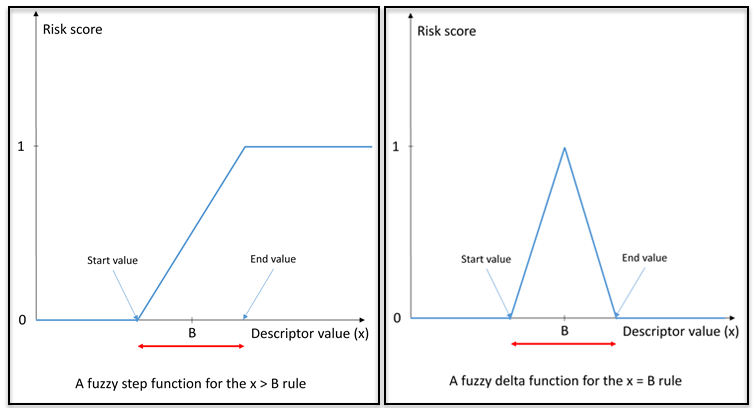
The boundaries of threshold regions in Risk rules are set off in the description below by square brackets, e.g., "MWt > [450,550]" is a soft version of Lipinski's 500 MWt cutoff. Within the .ro5 file itself, this would be expressed as "MWt > 450{500}" versus a sharp cut-off of "MWt > 500."
Note that Risk thresholds are based only on predictions that fall within the model's applicability domain. You should always check a Code to make sure that the corresponding prediction is within scope for the respective model before acting on the flag. It is also prudent to check the associated confidence and/or uncertainty estimate(s).
Other details
Differences between the distribution of values for the full data set and for those falling within the applicability domains for models were taken into consideration in selecting the exact thresholds chosen, as was information from the literature and related models. The naïve threshold for intrinsic clearance by CYP 3A4 (CYP3A4_CLint), for example, is exaggerated somewhat by the presence of prodrugs in the WDI subset we use to calibrate the thresholds and was reduced accordingly.
Highly correlated criteria were combined into single rules using Boolean operators. The Size rule includes four individual criteria, all of which use the “>” relational operator. Predictions falling below both threshold values contribute nothing to the Risk, whereas predictions falling above both contribute 1 violation “point”. Intermediate values represent intermediate risks: a compound of molecular weight 475 violates the first criterion and so would represent an incremental Risk of 0.5 points for that criterion. The rule for identifying overly large structures, for example, was:
Size: MWt > [450,500] OR N_Atoms > [30,35] OR MolVol > [470,520] OR N_Bonds > [35,40]
The mnemonic identifier for this rule is “Size”, which gets inserted into the associated ADMET Code string whenever the rule is violated. The mnemonics for the RuleOf5 rules given above are “Mw”, “LP”, “Hb” and “NO” for high molecular weight, log P and potential H-bond donors and acceptors, respectively.
Points are then combined across logical operators such as ORs and ANDs under the rules of fuzzy logic developed by Zadeh (1965): criteria connected by the OR operator yield the maximum of the component violation points and those combined using the AND operator yield the minimum. The combined points from the criteria making up a rule then yield an overall value between 0 and 1, which is multiplied by the weight assigned to the rule as a whole.
You can generate new binary (0 or 1) Risk Code attributes for each rule in ADMET_Risk using the ADMET Risk Codes option in the [Select From List dialog].