

2.2.1. Absorption Risk
The Absorption Risk model (Absn_Risk) includes eight rules based on descriptors and predicted properties licensed as part of the PhysChem model group, each of which contributes one vote to the score. Some rules were updated in 2026 to except important classes of bRo5 compounds. The rules are:
|
Size: |
(MWt > [450,500] OR N_Atoms > [30,35] OR MolVol > [470,520] OR N_Bonds > [35,40]) AND PROTAC = No AND Macrocycle = 0 (too large, except PROTACs and macrocycles) |
|---|---|
|
RotB: |
N_FrRotB > [8,10] AND PROTAC = No (too flexible, except PROTACs) |
|
HBD: |
HBDH > [3,5] AND HBDch > [1.5,2.0] (too many good H-bond donors) |
|
HBA: |
HBA > [7,10] AND HBAch < [-6.0,-5.0] AND ChameLogK < [0.35, 0.4] (too many good H-bond acceptors, except bRo5 compounds with chameleonic behavior) |
|
ch: |
NPA_ABSQ > [19,21] OR EPSA > [125,150] (excessive charge or EPSA) |
|
Kow: |
(S+logP > [4.5,5.0] OR S+logD > [3.5,4.0] OR MlogP > [3.5,4.0]) AND ChameLogK < [0.35, 0.4] (high logPoctanol-water, except bRo5 compounds with chameleonic behavior) |
|
Peff: |
S+Peff < [0.40,0.60] (low permeability) |
|
Sw: |
S+S_Intrins < [0.0015,0.003] (low intrinsic solubility) |
(Explanations of the various descriptors can be found here; links to models can be found in ADMET Properties.)
Absn_Risk is greater than or equal to 4.0 for 9% of the focused WDI subset. The rules that define it are stored in the ABSORPTION_WDI.ro5 file in the installation folder. The rules can easily be customized – e.g., to add a new rule, to specify fractional weights for a rule, or to alter the mnemonics - by creating a personal copy. The original Lipinski rules distributed with the program installation package are encoded in the Lipinski.ro5 file.
Applying Absorption Risk
Zhao et al. (2001) published a compilation of human intestinal absorption data on a range of drugs. The relationships between the reported fraction absorbed, RuleOf5 and Absn_Risk are shown below.
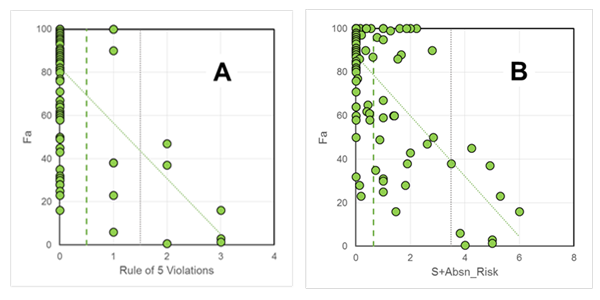
Neither filter produces any false negatives using the cutoffs identified in the respective WDI analyses – i.e., neither flags as “poorly absorbed” any compound for which the experimentally determined fraction absorbed is greater than 50%. Absn_Risk, however, picks out 50% more of the poorly absorbed compounds than does RuleOf5. Many of the 22 poorly absorbed compounds present are missed in both cases, however; the specificity is 0.27 for RuleOf5 vs 0.41 for Absn_Risk when poorly-absorbed compounds are taken as the negative class.
For RuleOf5, many of the poorly absorbed compounds are stacked on the Y-axis, and reducing the maximum allowed score from 1.5 to 0.5 – i.e., not allowing any violations – only raises the specificity to 0.425. Most poorly absorbed compounds are shifted well away from the Y axis for S+Absn_Risk, however, and setting the filter threshold to 0.65 (the vertical green dashed line in Figure 1B) raises the sensitivity to 0.864. The increase in specificity comes at the cost of some decrease in sensitivity (0.825 for rejecting Absn_Risk scores above 0.65 vs 0.97 for rejecting compounds with any RuleOf5 violations), but that trade-off may be worth the alternative risk of a program failing late in development.