

4.4.5. Clustering Molecular Pairs
The Pairs tab has a feature to cluster the pairs in such that a way that within each cluster, every pair exhibits the identical structural transformation. For example, a particular cluster might represent the addition of a hydroxyl group to an aromatic ring. An important use of this feature is to determine whether a given structural transformation is associated with a consistent change in a given property. For example, you might attempt to identify specific structural changes that are associated with a significant increase in solubility, focusing in particular on those structural changes for which the solubility increase is consistent for a large number of example pairs. Such structural changes might then be used to aid in molecule design efforts aimed at increasing solubility.
To generate pair clusters, use PAIRS>>Generate Clusters, or the dendrogram icon on the toolbar that appears when you have enabled Pairs tab:

The subsequent Pair clusters dialog allows you to specify a number of options and parameters.
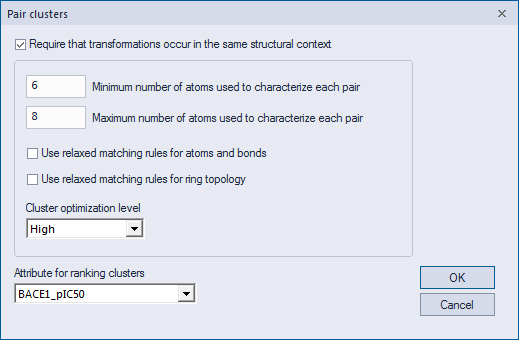
Require structural context requires that two pairs will be placed into the same cluster only if their transform occurs in the same structural context. As an example, if the context option is not selected, pairs in a cluster might all represent the addition of a hydroxyl group to any aromatic ring; meanwhile if the context option is selected, separate clusters could be created for ortho-, meta- and para-addition to an aromatic ring contained in a bi-phenyl motif. In general, the more structural context is required, the more consistent the corresponding property change is likely to be. However, clustering takes longer as more context is required, and the resulting clusters will contain fewer pairs in general.
Minimum characterization atoms is the minimum number of atoms in all substructures created to describe the relevant transformation. Increasing this number will increase the amount of required structural context, so will result in clusters that are smaller but more structurally homogeneous. It will also increase the computation time. Note that this option is available only when structural context is required.
Maximum characterization atoms is the maximum number of atoms in all substructures created to describe the relevant transformation. Increasing this number will increase the amount of required structural context, so will result in clusters that are smaller but more structurally homogeneous. It will also increase the computation time. Note that this option is available only when structural context is required.
Relaxed atom/bond rules is only used when structural context is required. This option specifies that the similarity of pairs should not consider atom and bond types. Activating this option will tend to result in clusters that are larger but less structurally homogeneous.
Relaxed topology rules is only used when structural context is required. This option specifies that the similarity of pairs should not consider ring topology. Activating this option will tend to result in clusters that are larger but less structurally homogeneous.
Optimization level determines the amount of time that is spent characterizing each pair in preparation for clustering. A higher level will produce better results (fewer, larger clusters), but the clustering will take more time to complete. The lower levels can be used when approximate results are satisfactory.
Attribute for ranking classes. If an attribute is selected, pairs will be ordered by cluster, such that pairs at the top belong to the cluster with the largest average change in the attribute.
Once pair clusters have been generated, you can visualize them one by one using the navigation buttons shown at the far right of the toolbar (see above).