

6.6.2. Dose Optimization
The minimal effective dose of a drug has significant implications for its safety (Smith 2009), the cost of producing it and how complicated its formulation requirements will be. Information concerning the expected therapeutic dose can drive structure-activity relationships, compound prioritization and identification of ADMET risks for particular chemical series. HTPK Simulation methodology can be very useful for dose prediction at these stages.
The HTPK Simulation Module is a streamlined version of the way GastroPlus estimates the dose of a compound required to produce a therapeutically effective concentration (Ceff) of a compound. The Ceff represents the average total plasma concentration at steady-state needed to produce the desired effect.
The inputs required are similar to those discussed in the previous section and can be calculated from ADMET Predictor model outputs or from descriptors. They are calculated from molecular structure alone or supplied by the user, whereas Ceff must be supplied by the user, preferably in the form of per-compound auxiliary data. Typically it is calculated from a Ki or an IC50. If the Ceff cannot be reached below the default dosing limit of 1,000 mg for a human and 100 mg for a rat or mouse, the model will report the limit dose instead and flag the prediction as out-of-scope.
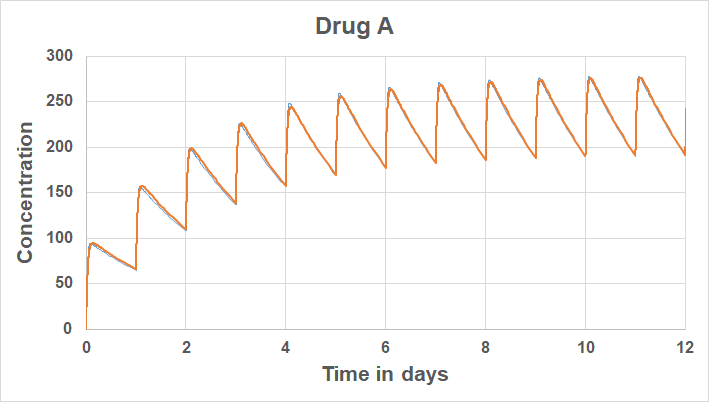
The plot below shows the Cp-time profile for a once-a-day dosing regimen with Drug A, whose steady state is achieved after about 10 days. The Ceff is calculated as the AUC of the final (steady state) dosing interval divided by the dosing interval. By default, the optimized dose is calculated by varying the daily dose, starting with initial guess and running simulations until the target Ceff at the steady state is attained. Once the difference between the target and actual steady state Ceff for subsequent trial dosing levels is within acceptable tolerance (5%), the process stops and reports the dose as being an optimal one.
The optimal dose calculation takes more time than is required to compute %Fa and %Fb because it typically extends across a longer time period and because several different doses must be tried before one is found that hits the target.