

2.5.2.Clearance Classification
The Extended Clearance Classification System (ECCS) proposed by Varma et al. (2015) divides physicochemical property space on the basis of ionization (acids and zwitterions vs. bases and neutrals); permeability (predicted or measured Papp above or below 5×10⁻⁶ cm/s for low-efflux MDCK cell monolayers); and molecular weight (below or above 400). Ionization group and permeability divide the space into quadrants, and the two quadrants containing acidic and zwitterionic compounds are subdivided based on molecular weight. This yields six classes in all: 1A, 1B, 2, 3A, 3B and 4. Having examined a data set of 739 drugs from in the literature for which clearance information was publicly available, they were able to identify 307 with a molecular weight below 700 and for which metabolism (primarily by CYPs), renal clearance or hepatic uptake (primarily by OATPs) accounted for at least 70% of clearance. Those 307 drugs were distributed across the six classes based on their physical properties - measured where available and estimated in silico where they were not.
Varma et al. reported the following distribution of drugs and clearance pathways:
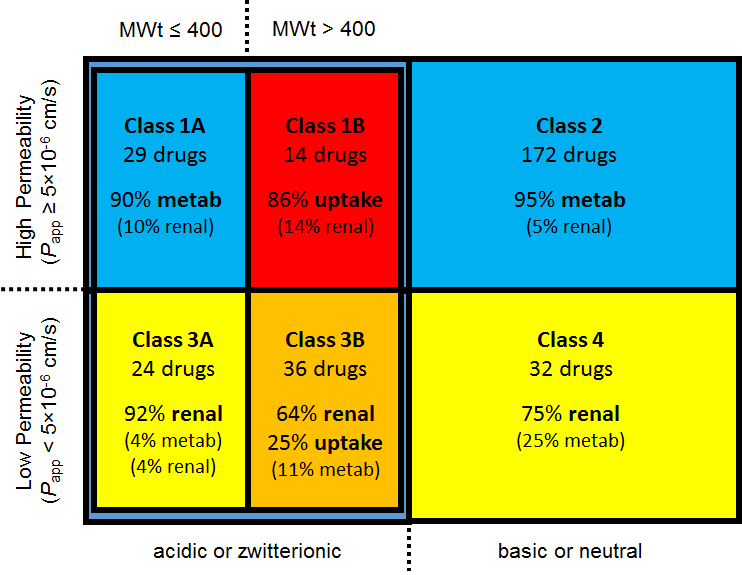
Based on these results, they identified Class1A and Class 2 membership with metabolic clearance; Class 3A and Class 4 membership with renal clearance; Class 1B membership with clearance controlled by hepatic uptake; and Class 3B membership with clearance by renal excretion or hepatic uptake (not to be confused with a mix of clearance mechanism).
Measured permeabilities were only available for 175 of the drugs. When only the distribution of that subset was considered, the fraction in Class 3B for which hepatic uptake was limiting rose from 25 to 57%. The fraction in Class 4 that are cleared metabolically, on the other hand, fell from 25 to 16%. These shifts led the authors to identify Class 3B as "mixed" but to identify Class 4 specifically with renal clearance. Given that assignments made in ADMET Predictor are based on calculated properties, the distribution shown above is more representative of the results you should expect.
ECCS class assignment in ADMET Predictor
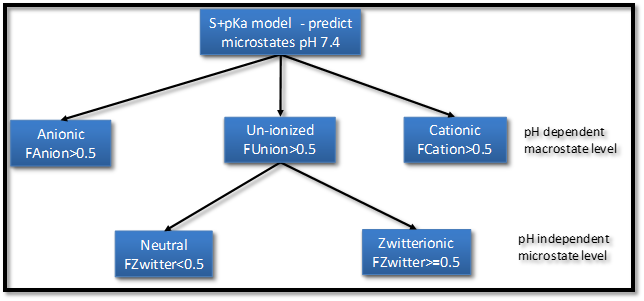
The ECCS_Class model in ADMET Predictor is designed to reproduce Varma et al.'s classifications. It uses FAnion, FCation, FUnion and FZwitter at pH 7.4 to categorize each molecule as anionic, cationic, zwitterionic or unionized, whereas Varma et al. relied on pKa's and a reference pH of 7.0. In addition, they used data from an in-house, low-efflux MDCK cell line assay to assess or predict permeability, whereas S+MDCK is based on the parent cell line. We use an ANNE model (S+MDCK-LE) constructed using the permeability classifications reported for 304 drugs from their data set (three compounds from chiral pairs were dropped as redundant; both members of each pair had the same dominant clearance pathway and are not distinguishable in Predictor).
Despite the differences in the details of how ionization and permeability categories are assigned, our implementation yields a very similar distribution of clearance mechanisms across the ECCS classes, as shown below.
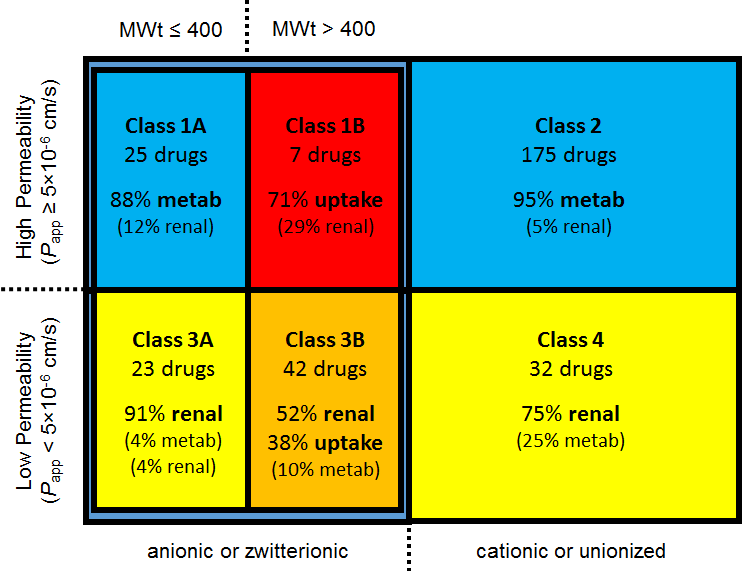
The main difference is a shift of seven compounds from Class 1B to Class 3B. All of them are cleared by hepatic uptake, and five have S+MDCK-LE Low prediction confidences below 60%, i.e., they lie just below the model threshold. In fact, the experimental permeability for one of those five - glipizide - falls on the 5.0×10⁻⁶ cm/s threshold, and that for another - atorvastatin - lies only 10% above it, at 5.5×10⁻⁶ cm/s.
Assignment of the drugs in the Varma data set to specific ionization states is straightforward, but this is not always the case. A substantial portion of many compounds that might be encountered in discovery and development exist in a mix of ionization states at physiological pH. Such compounds are labeled as Multiclass in ECCS_Class rather than being (misleadingly) assigned to any single class. In addition, assignments for compounds with molecular weight above 700 (which would have been excluded from the Varma analysis) are qualified by addition of High_MWt to the output class.
Alternative clearance models
There is a clear trade-off between the simplicity of the properties used to partition the drugs and the "purity" of each ECCS class with respect to clearance pathway. An alternative approach is to build a model that uses molecular descriptors to classify compounds directly by how they are cleared (Toshimoto 2014). In this spirit, the 304 drugs in the Varma data set were used to build a three-way (ternary) ANNE classification model (S+CL_Mech) that assigns the clearance class (renal, metabolic or hepatic uptake) directly, thereby complementing the ECCS_Class model.
S+CL_Mech assumes that exactly one of three clearance pathways - metabolism, renal extraction or hepatic uptake - is rate limiting; neither "none of the above" or "some of the above" is an option. Applying the ECCS involves a similar assumption. When Kusama et al. (2010) grouped drugs by their physicochemical properties, they noted that many drugs show a mix of clearance mechanisms. That is consistent with Varma et al. only being able to characterize 307 of 739 drugs as being cleared predominantly (>70%) by a single mechanism. That the Varma dataset consists entirely of approved drugs represents a significant limitation for its scope of applicability, but one that is hard to get around: only approved drugs are likely to have been characterized thoroughly enough to assign a dominant clearance mechanism - especially with regard to hepatic uptake.
We sought to broaden the usefulness of clearance pathway analysis by also constructing binary models from the Varma data set, with the expectation that they might be more suitable when analyzing leads and analogs that might not have a single dominant clearance mechanism:
S+CL_Metab predicts whether or not the rate-limiting clearance step is metabolic.
S+CL_Renal predicts whether or not renal excretion dominates clearance.
S+CL_Uptake predicts whether or not hepatic uptake is rate-limiting.
A major virtue of this approach is that confidence estimates can be made for individual binary model predictions. Such estimates not available for multiclass models, because the technique used for binary models is not readily extensible to them.
All five clearance models appear near the far right of the spreadsheet on the PhysChem tab.
Reconciling clearance model predictions
The ECCS_Class and S+CLxxx models are built from the same data set, so their predictions will usually agree. This is illustrated below using five compounds drawn from Demo2D.qmd or the training set used to build the CYP_HLM_CLint model. View >> Spreadsheet Heat Map... was used to color-code the S+CL_Metab, S+CL_Renal, S+CL_Uptake and ECCS_Class predictions. Predictions from OATP1B1_Inh and CYP_HLM_CLint are provided for reference.
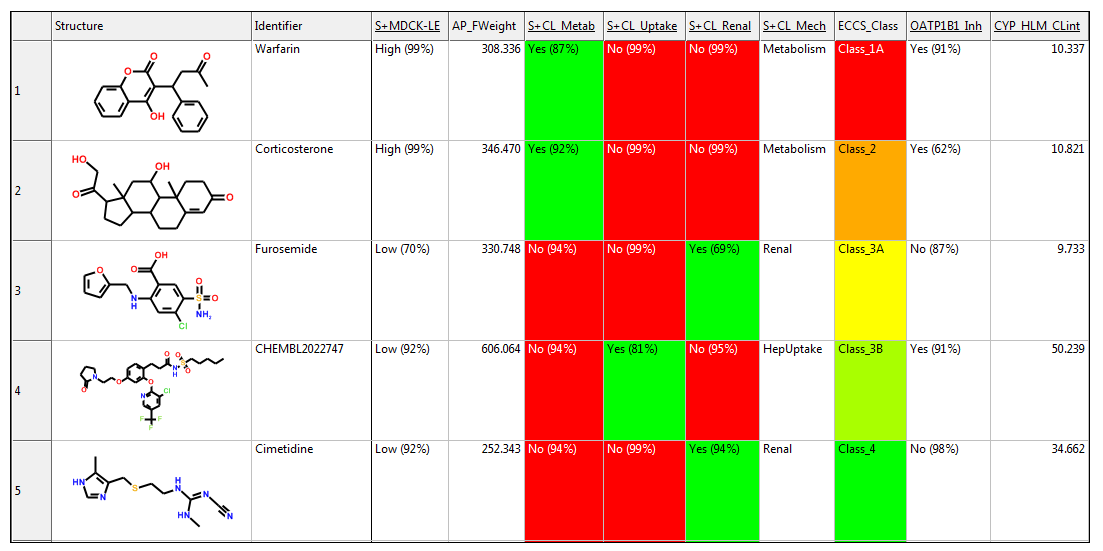
The former is an indicator of likely affinity for OATP transporters and the latter predicts microsomal clearance. Factors such as tight binding to plasma proteins can offset either, so a "Yes" prediction from OATP1B1_Inh by or a high predicted CLint are consistent with hepatic uptake or metabolism limiting clearance but neither is definitive. That said, 21 of 22 drugs (95%) in the data set that are limited by hepatic uptake are predicted to be OATP1B1 inhibitors, whereas only 44 of the 282 (16%) for which renal or metabolic clearance dominates get labeled Yes. Similarly, 42 of 44 drugs (95%) for which CYP_HLM_CLint is greater than 50 μL/min/mg HLM protein are cleared metabolically.
Though they are built on the same dependent variable, each model uses a different set of descriptors and looks at the endpoint from a slightly different perspective. Hence their predictions for compounds outside the training set are somewhat independent: they usually concur but not necessarily completely or in all cases. Most discrepancies are "soft", as illustrated by the five compounds shown below. In each case, at least one prediction is nominally inconsistent with others in the group.
Confidence estimates for the nominally inconsistent binary classifications in the first two rows (1&2) are very low. In the third case, all three binary predictions are No but the one where Yes would be consistent with the S+CL_Mech and ECCS_Class predictions - S+CL_Metab (3) - is a very weak negative: the confidence estimate is only 44%. The fourth row is similar, though the discordant No for S+CL_Uptake (4) has a somewhat higher confidence (69%).
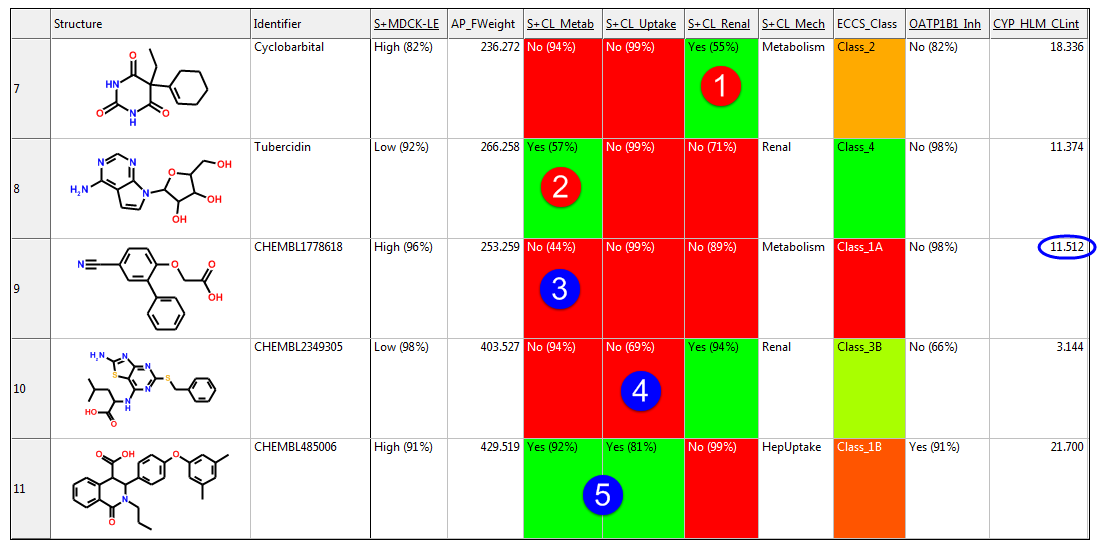
The last row is more interesting, in that the binary models confidently suggest a mix of metabolic clearance and hepatic uptake (5); the latter is more consistent with the S+CL_Mech and ECCS_Class predictions.
Recall that S+CL_Mech and ECCS_Class presume that a single (dominant) clearance pathway exists, but that the binary classification models do not. Hence the best interpretation for this combination of predictions is that both metabolism and hepatic uptake probably contribute to clearance. As it happens, microsomal CYP clearance is predicted (correctly) to be relatively low for all of the compounds. Cyclobarbital and tubercidin are, in fact, cleared very slowly, which makes the low binary confidences appropriate.
There are a few compounds for which disagreements in predicted clearance pathways are not so readily reconciled. Majority rule would suggest that clearance for the first two compounds shown below would be predominantly renal (1) and metabolic (2). Both predicted microsomal CYP clearances are low, which is consistent with the assignment for the first compound but not for the second. The ECCS_Class (3A) indicates that hepatic uptake or renal clearance dominate, which seems more likely.
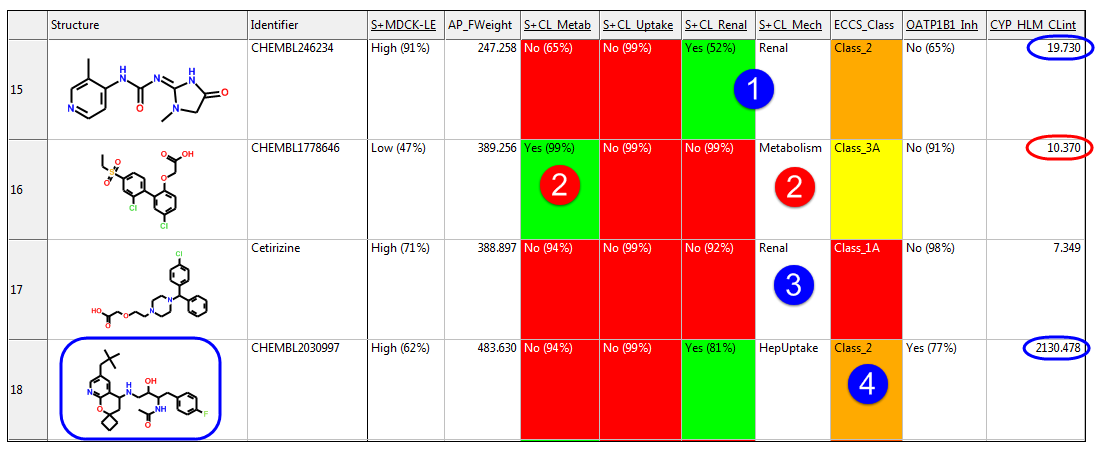
The binary models all return No for the third compound (cetirizine), whereas the ECCS_Class (1A) and S+CL_Mech indicate hepatic uptake and renal clearance, respectively (3). The latter is the correct assignment. All three pathways are predicted to contribute to clearance of the last compound. The high predicted microsomal CYP clearance and the absence of a carboxylic acid group for an OATP to recognize makes metabolic clearance most likely (4), but - absent confidence estimates - that assignment is tentative, at best.
Performance
Our S+MDCK-LE ANNE model agrees very well with the experimental permeability classification from Varma et al.
|
Model |
Set |
Negatives |
Positives |
Total |
Correct |
Concordance |
Sensitivity |
Specificity |
|---|---|---|---|---|---|---|---|---|
|
S+MDCK-LE |
Training |
84 |
179 |
263 |
252 |
95.8% |
96.1% |
95.2% |
|
Test |
49 |
25 |
74 |
65 |
90.2% |
88.2% |
100.0% |
Evaluating the alternative clearance classification models is complicated, for several reasons. For one thing, there is no held-out test set for the ECCS_Class model. For another, ECCS_Class and S+CL_Mech are ternary models, so neither "positive vs. negative" nor the associated "sensitivity vs. specificity" distinctions are well defined, as they are for the binary models. Finally, ECCS_Class is "fuzzy", in that both renal and hepatic uptake clearance are identified with Class 3B.
The first point is addressed in the table below by splitting out statistics by All and Test sets rather than the usual Train and Test. The second point is addressed by providing the three piecemeal, one-against-all binary statistics (e.g., Metabolism vs. not Metabolism (i.e., Renal or HepUptake clearance) as well as the overall values, which are highlighted in italics in the table below. Note that the "S+" prefixes have been dropped from the model names for clarity.
|
Model |
Set |
Negatives |
Positives |
Total |
Correct |
Concordance |
Sensitivity |
Specificity |
|---|---|---|---|---|---|---|---|---|
|
ECCS_Class
|
All |
103 |
201 |
304 |
279 |
92% |
94% |
88% |
|
ECCS_Class
|
All |
223 |
81 |
304 |
260 |
86% |
83% |
87% |
|
ECCS_Class
|
All |
282 |
22 |
304 |
275 |
91% |
96% |
90% |
|
ECCS_Class
|
All |
--- |
--- |
304 |
280 |
92% |
--- |
--- |
|
CL_Mech
|
All |
103 |
201 |
304 |
274 |
90.1% |
87.5% |
95.1% |
|
Test |
8 |
32 |
40 |
32 |
97.5% |
96.9% |
100% |
|
|
CL_Mech
|
All |
223 |
81 |
304 |
273 |
90.7% |
91.3% |
90.5% |
|
Test |
37 |
3 |
40 |
3 |
95% |
100% |
95% |
|
|
CL_Mech
|
All |
282 |
22 |
304 |
296 |
97.3% |
95.4% |
97.5% |
|
Test |
36 |
4 |
40 |
3 |
97.5% |
75.0% |
100.0% |
|
|
CL_Mech
|
All |
--- |
--- |
304 |
273 |
89.1% |
--- |
--- |
|
Test |
--- |
--- |
40 |
38 |
95.0% |
--- |
--- |
|
|
CL_Metab |
All |
103 |
201 |
304 |
293 |
96.4% |
96.0% |
97.1% |
|
Test |
17 |
34 |
51 |
47 |
92.2% |
91.2% |
94.1% |
|
|
CL_Renal |
All |
223 |
81 |
304 |
285 |
93.8% |
93.8% |
93.7% |
|
Test |
41 |
10 |
51 |
48 |
94.1% |
90.0% |
95.1% |
|
|
CL_Uptake |
All |
282 |
22 |
304 |
301 |
99.0% |
95.5% |
99.3% |
|
Test |
41 |
7 |
48 |
47 |
97.9% |
85.7% |
100.0% |
As noted above, the five models make predictions that are typically more or less similar or complementary. Arguably the best way to compare their performance is on the basis of their generalized [Youden's J statistic] for the full data set; the underrepresentation of the Renal class in the S+CL_Mech test set biases comparisons made on that basis.
The binary models will likely be most useful when working on discovery or early development compounds and your focus is on which pathways may contribute to clearance, in part because they come with confidence estimates. S+CL_Mech can be useful in that context by providing an indication of which pathway is likely to dominate clearance. ECCS_Class is the least reliably predictive, but that should not be surprising. After all, it relies on physicochemical properties to assign clearance mechanisms that involve molecular recognition by enzymes and transporters.