

2.9.4. MDR3
MDR3 (multidrug resistance protein 3) is mostly expressed in the liver on the canalicular membrane of hepatocytes. It transports phosphatidylcholine from the inner to outer leaf of the canalicular membrane, which is crucial to formation of bile. Thus, inhibition of MDR3 may lead to cholestasis. Temesszentandrási-Ambrus et al. developed an assay to measure MDR3 inhibition with digoxin as the substrate. Several compounds were tested including those known and known not to produce drug-induced liver injury (DILI). The most active compound tested was zosuquidar with an IC50 of 0.07 µM. Two models, a classification model (MDR3_Inh) and a regression model (MDR3_IC50, were built using the data. The cutoff for the classification model is 5 µM and allows one to incorporate qualitative results, e.g., >20 µM. The statistics for the MDR3_Inh are shown in the table below.
|
Model |
Set |
Negatives |
Positives |
Total |
Correct |
Concordance |
Sensitivity |
Specificity |
|---|---|---|---|---|---|---|---|---|
|
MDR3_Inh |
Training |
14 |
19 |
33 |
33 |
100.0% |
100.0% |
100.0% |
|
Test |
2 |
2 |
4 |
4 |
100.0% |
100.0% |
100.0% |
The dataset to build the MDR3_IC50 model contained 21 compounds, of which 3 were in the test set. The plot below shows the observed log of MDR3 IC50 versus the predicted values.
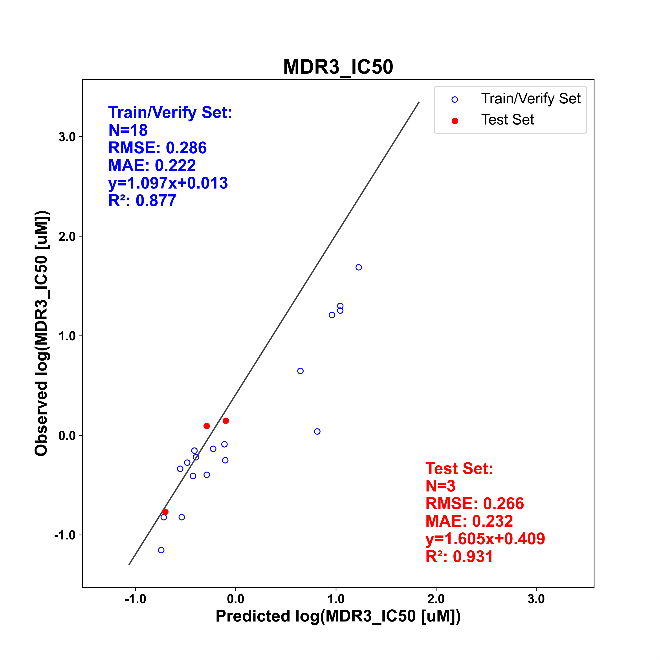
The classification and regression models should be considered together. The classification model will be more accurate than the regression model. For example, if the classification model predicts “Yes” and the regression model predicts 50 µM then the molecule is more likely to have an IC50 below 5 µM.