2.13.2. Solubility in Biorelevant Media
Successful pharmaceutical development requires that drug candidates have adequate solubility to dissolve in the gastrointestinal tract before being excreted. Most drug development programs measure solubility in phosphate buffer at two pH values reflecting typical pH of the stomach (pH 1.3) and small intestine (pH 6.5). The solubility obtained using this method can be valuable in predicting in vitro dissolution using standard USP dissolution methods and apparatus. In vivo the dissolution will vary depending on the nature of the physicochemical and biopharmaceutical properties of the molecule and on a number of physiological parameters.
One of the most significant sources of differences between in vitro dissolution in aqueous media and in vivo dissolution is the presence of bile salts in vivo. Measuring and predicting the influence of bile salts on drug dissolution in vivo has been the subject of a number of studies (Bakatselou 1991; Mithani 1996; Charman 1997; Galia 1998; Nicolaides 1999; Takano 2008). Several groups have developed recipes for biorelevant media that attempt to reproduce in vivo conditions in the in vitro dissolution experiments (Dressman 2000; Vertzoni 2004; Sunesen 2005; Wei 2006; Jantratid 2008; Okazaki 2008; Schwebel 2011).
For weakly basic drug molecules, precipitation is almost as important as dissolution. Several groups have recently begun to study the rates of precipitation in biorelevant media (Kostewicz 2004; Stuart 2005; Box 2006, 2008 & 2009; Dai 2007). In silico simulations of gastrointestinal absorption have been reported to more accurately reproduce in vivo results when parameterized with physicochemical properties based on solubility in biorelevant media (Jones 2006; Okumu 2009; Parrott 2009; Shono 2009). Even regulatory practices are beginning to feel the impact of dissolution testing in biorelevant media (Yazdanian 2004).
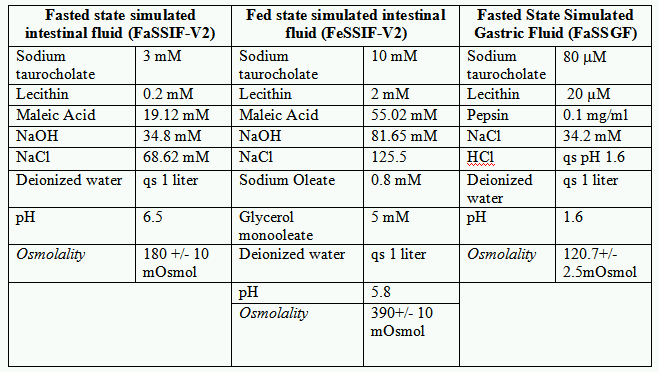
In 2008 Simulations Plus commissioned a laboratory at the Northeastern University (Boston MA) to measure solubilities of 160 diverse drug-like compounds in FaSSGF, FaSSIF, and FeSSIF. All measurements were carried out at 37 degrees Celsius. A common liquid chromatographic (LC) protocol using a standard gradient in 0.15% trifluoroacetic acid (TFA) and acetonitrile as the mobile phase was used. This is similar to the methodology previously used to measure the solubility of a large number of drug compounds in PEG solutions (Persson 2005; Rytting 2005). Biorelevant solubility media were prepared as specified by Jantradid et al. (2008):