2.13.4. Lipole Moment
Two of the new descriptors that have been added as of ADMET Predictor X.4 are T_Lipole and Lipole__3D. They are analogous to the corresponding dipole moment descriptors. However, instead of calculating moments with respect to partial atomic charge, the calculated moments are with respect to estimates of atomic lipophilicities (hence, the name lipole moment). Just as dipole moment measures the degree of separation of positive and negative charge in a molecule, lipole moment is intended to measure the degree of separation of hydrophobic (lipophilic) vs. hydrophilic (lipophobic) regions of the molecule. Molecules with a large lipole moment are expected to behave as amphiphiles and possibly exhibit a tendency toward micelle formation.
To obtain estimates of atomic lipophilicity, the following procedure was used. Almost 13,000 experimental logP’s were used as a training set, compiled from Starlist and other public sources. For consistency in the parameterization, we wanted groups such as carboxylic acids to always be “effectively” in the neutral form. Since logP measures the partition coefficient of the uncharged molecule (for molecules with no net permanent charge), the logP of a molecule containing a simple carboxylic acid is determined from the state of the molecule in which the carboxylic acid is unionized. However, for molecules, such as amino acids, that are zwitterions, the carboxylic acid moiety is ionized in the molecule’s uncharged macrostate. To deal with this issue, the experimental logP’s were “corrected” to the estimated logPu of the molecule in the uncharged and unionized form as follows:
'%3e%3cg transform='translate(167%2c0)'%3e%3cg transform='translate(-13%2c0)'%3e%3cg transform='translate(0%2c-88)'%3e%3cuse xlink:href='%23MJMATHI-4C' x='0' y='0'%3e%3c/use%3e%3cuse xlink:href='%23MJMATHI-6F' x='681' y='0'%3e%3c/use%3e%3cuse xlink:href='%23MJMATHI-67' x='1167' y='0'%3e%3c/use%3e%3cg transform='translate(1647%2c0)'%3e%3cuse xlink:href='%23MJMATHI-50' x='0' y='0'%3e%3c/use%3e%3cuse transform='scale(0.707)' xlink:href='%23MJMATHI-75' x='908' y='-213'%3e%3c/use%3e%3c/g%3e%3cuse xlink:href='%23MJMAIN-3D' x='3072' y='0'%3e%3c/use%3e%3cuse xlink:href='%23MJMATHI-4C' x='4128' y='0'%3e%3c/use%3e%3cuse xlink:href='%23MJMATHI-6F' x='4810' y='0'%3e%3c/use%3e%3cuse xlink:href='%23MJMATHI-67' x='5295' y='0'%3e%3c/use%3e%3cuse xlink:href='%23MJMATHI-50' x='5776' y='0'%3e%3c/use%3e%3cuse xlink:href='%23MJMAIN-2212' x='6750' y='0'%3e%3c/use%3e%3cuse xlink:href='%23MJMATHI-6C' x='7750' y='0'%3e%3c/use%3e%3cuse xlink:href='%23MJMATHI-6F' x='8049' y='0'%3e%3c/use%3e%3cuse xlink:href='%23MJMATHI-67' x='8534' y='0'%3e%3c/use%3e%3cuse xlink:href='%23MJMAIN-5B' x='9015' y='0'%3e%3c/use%3e%3cuse xlink:href='%23MJMAIN-28' x='9293' y='0'%3e%3c/use%3e%3cuse xlink:href='%23MJMAIN-31' x='9683' y='0'%3e%3c/use%3e%3cuse xlink:href='%23MJMAIN-2212' x='10406' y='0'%3e%3c/use%3e%3cg transform='translate(11406%2c0)'%3e%3cuse xlink:href='%23MJMATHI-46' x='0' y='0'%3e%3c/use%3e%3cuse transform='scale(0.707)' xlink:href='%23MJMATHI-7A' x='910' y='-213'%3e%3c/use%3e%3c/g%3e%3cuse xlink:href='%23MJMAIN-29' x='12481' y='0'%3e%3c/use%3e%3cuse xlink:href='%23MJMAIN-2B' x='13093' y='0'%3e%3c/use%3e%3cg transform='translate(14093%2c0)'%3e%3cuse xlink:href='%23MJMATHI-46' x='0' y='0'%3e%3c/use%3e%3cuse transform='scale(0.707)' xlink:href='%23MJMATHI-7A' x='910' y='-213'%3e%3c/use%3e%3c/g%3e%3cuse xlink:href='%23MJMAIN-2217' x='15390' y='0'%3e%3c/use%3e%3cg transform='translate(16113%2c0)'%3e%3cuse xlink:href='%23MJMAIN-31'%3e%3c/use%3e%3cuse xlink:href='%23MJMAIN-30' x='500' y='0'%3e%3c/use%3e%3cg transform='translate(1001%2c393)'%3e%3cuse transform='scale(0.707)' xlink:href='%23MJMAIN-2212' x='0' y='0'%3e%3c/use%3e%3cg transform='translate(550%2c0)'%3e%3cuse transform='scale(0.707)' xlink:href='%23MJMAIN-32'%3e%3c/use%3e%3cuse transform='scale(0.707)' xlink:href='%23MJMAIN-2E' x='500' y='0'%3e%3c/use%3e%3cuse transform='scale(0.707)' xlink:href='%23MJMAIN-34' x='779' y='0'%3e%3c/use%3e%3cuse transform='scale(0.707)' xlink:href='%23MJMAIN-34' x='1279' y='0'%3e%3c/use%3e%3c/g%3e%3cuse transform='scale(0.707)' xlink:href='%23MJMAIN-29' x='2558' y='0'%3e%3c/use%3e%3c/g%3e%3c/g%3e%3cuse xlink:href='%23MJMAIN-5D' x='19299' y='0'%3e%3c/use%3e%3c/g%3e%3c/g%3e%3c/g%3e%3c/g%3e%3c/svg%3e)
where Fz is the fraction zwitterionic (as determined using ADMET Predictor’s pKa model) and the value of 2.44 was obtained from an empirical fit of ~2500 experimental logD’s to experimental logP’s, and pKa’s of zwitterionic species. The equation may be derived by recognizing that the measured partition coefficient, P, is an average of P in the uncharged/unionized state, Pu, and the uncharged zwitterionic state, Pz. The averaging is based on the fractional amount of the zwitterionic state, Fz, and the amount in the uncharged/unionized state, (1 - Fz), and by the estimated approximate difference of 2.44 between logPu and logPz. These relationships can be represented by the following equations:
The resulting logPu’s were then fit to atomic hydrophobicity values which depended on the atom’s E-state and I-state (intrinsic state) as follows.
where the summation index i denotes E-state/I-state type, e.g. SsCH3 as an example, and the sum is over all E-state types. The weights, ai and bi, which depend on E-state type, were determined by a multiple linear regression fitting the calculated logPu’s to the estimated values as described above. The fitting procedure involved the fit of 102 weights (a and b) to almost 13,000 estimated logPu values. Only heavy atom E-states and I-states were used in this procedure. The fit achieved an RMSE of 0.69 log units. This is considerably worse than the RMSE for the S+logP model. However, this is to be expected as the S+logP model is considerably more complex, being an ANNE model utilizing many more descriptors, not just atomic parameters. The goal is not to accurately predict logPu, but to extract reasonable atomic parameters that may be used to estimate the lipole moment.
The weights, a and b, may now be used to estimate atomic lipophilicities as follows. A molecule’s E-state, Si, is the sum of the atomic E-states over all atoms belonging to E-state type i, i.e.,
where the sum is over all atoms belonging to E-state type i, and Sk is the atom’s E-state value. Similarly, the molecular I-state, Ii, is the sum over all atoms belonging to E-state type i having atomic I-state, ik. In this case, we may define an atomic lipophilicity for atom k belonging to E-state type i as:
The calculated logPu can then be written as
showing that the molecule’s logPu has been decomposed into atomic contributions.
Now, analogously, to dipole moment, the lipole moment has been defined by Pedretti et al (2002) as:
where the sum is over the product of the atom’s lipophilicity and its coordinates. Unfortunately, unlike the case of dipole moment, where, for neutral molecules, the dipole moment is independent of coordinate origin, because the charges sum to zero, that is not the case for lipole moment. Consequently, as a matter of practicality, we choose the molecule’s center of geometry as the coordinate origin for consistency. The value of the Lipole__3D descriptor is then simply the magnitude of the lipole moment for molecules with 3D coordinates. Its topological equivalent, T_Lipole is determined by the same procedure as used for T_Dipole.
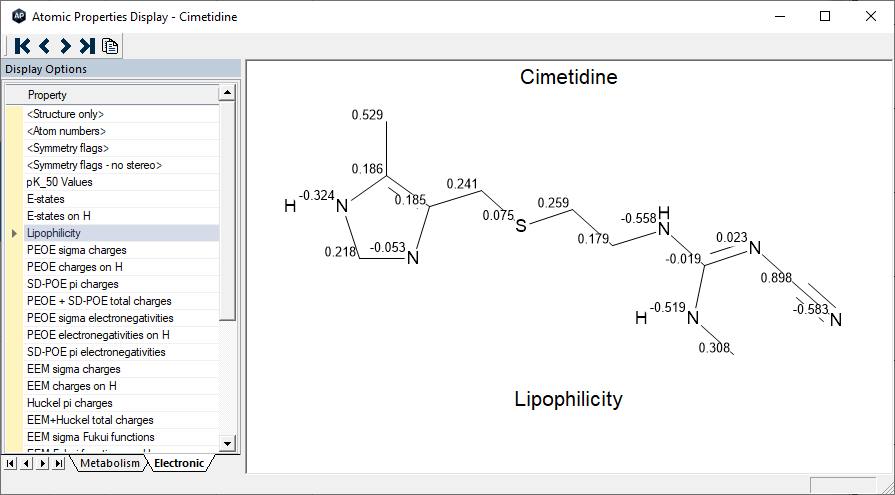
The atomic lipophilicities, lk, may be displayed in the Atomic Properties window as shown below.