

3.2.2. Selecting a Modeling Protocol
The various dialog sections covered on this page allow you to set or adjust the parameters that control the model building process. These include:
-
The Model type and prediction method section indicates which kind of model you want to build. In this case, Artificial Neural Network (ANN) has been selected on the Regression tab.
-
The Test set selection section indicates how the input data is to be partitioned into training, verification and test sets.
-
The Descriptor parameters section specifies how descriptors you selected will be filtered and prioritized for consideration during model building.
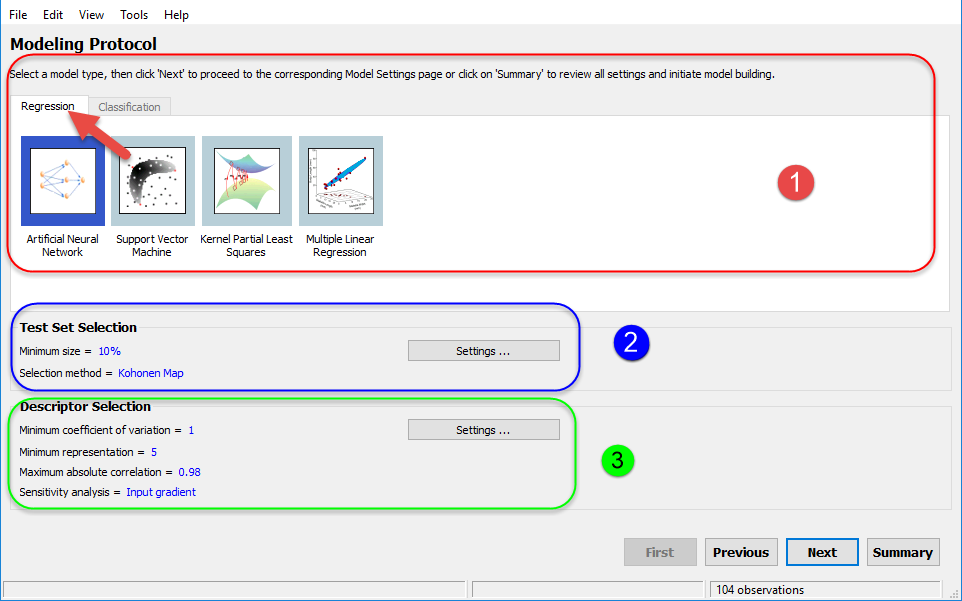
Model type and prediction method (1)
The first thing to decide is which method to use in generating predictive models from descriptors and observed data. There are many ways to use descriptors to predict properties. These include multiple linear regression, kernel partial least squares, artificial neural networks, and support vector machines.
If the dependent variable is numeric, ADMET Modeler will initially select the Regression tab. There are four options for building regression models:
-
Artificial Neural Network (ANN) models are nonlinear, with hidden neurons between the inputs and output; they are our preferred methodology.
-
Support Vector Machine (SVM) models try to find "soft" hyperplanes (support vectors) based on the input variables or transforms thereof such that the distances in (transformed) descriptor space to the hyperplanes can be used to estimate the dependent variable value.
-
Kernel Partial Least Squares (KPLS) analysis generates a series of orthogonal linear combinations of the descriptors or transforms thereof (components) and regresses the dependent variable on them.
-
Multiple Linear Regression (MLR) models are linear functions of the input variables.
You can build classification models for a textual dependent variable (e.g., Yes/No, Active/Inactive) and for a numeric one that takes on 16 or fewer distinct values within the data set. If the dependent variable is textual, ADMET Modeler will automatically switch over to the Classification methods tab. Both ANN and Support Vector Machine options are supported for building multiclass models (i.e., data sets that include more than two different labels) as well as for building binary classification models.
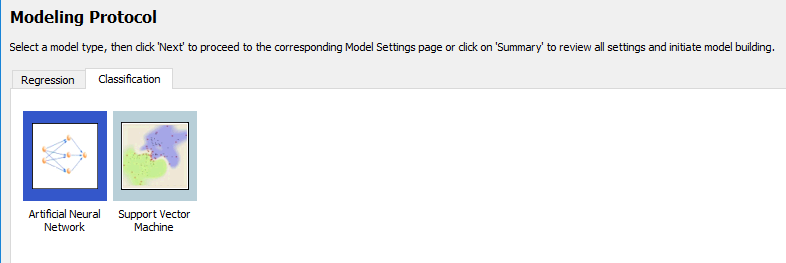
If the specified dependent variable takes on more than 16 values, the classification tab will be disabled and you will be redirected to the Regression tab. Regression models can be built from binary and other numeric dependent variables by toggling back to the Regression tab.
By default, the minimum test set size is set to 10% of the input data and ADMET Modeler guides data set partitioning using our own implementation of the Kohonen mapping method described by Yan & Gasteiger (2003). The technique uses stratified sampling by structure (May 2010) to set up the training pool and typically gives good results for medium-sized data sets, provided sufficient care is taken to avoid overtraining.
You can modify the test set size and how it will be chosen by clicking on Settings... Other options include stratified sampling, random selection, manual specification and K-means clustering. K-means is a good choice for large data sets, where Kohonen mapping may be unduly time-consuming. Random selection minimizes the risk of bias but may produce unrepresentative training or test sets, especially when the amount of available data is limited.
Descriptor selection provides controls for filtering descriptors, removing those with low-variance as well reducing the number that are correlated with each other. They are then subjected to sensitivity analysis to rank them, which determines the order in which they will be incorporated during model building.