

A modeler can apply all qualified descriptors to train a model, but not all qualified descriptors are equally well correlated with the target property to be modeled or are equally informative. The presence of less relevant descriptors makes it more difficult to train the model, because the learning algorithm has to distinguish between the real information and the noise. In addition, processing more descriptors will increase the computational cost without necessarily gaining much in accuracy. To build better models efficiently, then, it is desirable to remove descriptors that contribute little additional information to the data set and to give priority to descriptors that are influential with respect to the target property.
In ADMET Modeler, this is done in two stages. In the first, the number of descriptors is reduced based on their own properties and how they relate to other descriptors; this is an "unsupervised" process. The second, "supervised" stage takes the relationship of the descriptors to the dependent variable - their "sensitivity" - into account in prioritizing them for incorporation during model building.
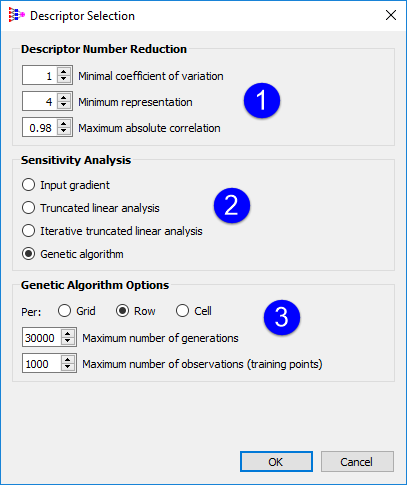
The Descriptor Number Reduction field (1) lets you adjust the stringency with which descriptors are filtered out of the ones you have selected for consideration. Minimal coefficient of variation controls the relative amount of variation (in percent) a variable needs to have for it to be used as a descriptor. The Minimum representation setting, in contrast, applies to dependent variables as well as to descriptors, though in somewhat different ways. For descriptors, it sets the smallest number of non-zero values a variable needs to exhibit for it to be used as a descriptor. It is also the minimum number of observations that need to be present in each class for an attribute to be used as a categorical dependent variable.
The Maximum absolute correlation controls how highly correlated descriptors are allowed to be. If more than the maximum allowed amount of variation in any descriptor can be "explained" by the other descriptors, the least informative descriptor is eliminated. In order to speed up the multiway correlation analysis, a pairwise check for correlation is performed first, with descriptors further down the list being retained preferentially.
The Sensitivity Analysis field determines which variable selection method will be used to order the descriptors for inclusion in the model. Truncated linear analysis (TLA) uses a modified MLR analysis to determine the relative importance of descriptors. It is the fastest method and is the default. Iterative truncated linear analysis (ITLA) applies TLA to rank-transformed descriptors, then tracks the explanatory power of more informative descriptors after less informative ones have been eliminated. It is also fast, though not quite as fast as TLA.
TLA and ITLA both yield the same descriptor sensitivity rankings for all architectures in a model grid. Input gradient, in contrast, uses all selected descriptors to run an artificial neural net (ANN) analysis at each neuron level, so each row of architectures sees the same sensitivity ranking but that ranking is different from row to row. The Input gradient method is slower to run than TLA or ITLA.
The final option for doing sensitivity analysis is to use a Genetic algorithm (GA). Selecting that option reveals the Genetic Algorithm Options shown in the illustration above. As one might expect, running the GA for the Grid as a whole is faster than running it for each Row, which in turn is faster than running it on each Cell in the grid. Offsetting that is the fact that the more focused models are often sufficiently better to justify the increased computational investment.
Evolution can easily become an endless process, so it is wise to set a reasonable Maximum number of generations. For large data sets, subsampling is used to reduce the computational load. The Maximum number of observations option allows you to control how large the subsamples involved are.
Section 3.4.3 provides more details on how the various sensitivity methods work.