

Aldehyde Oxidase (AOX)
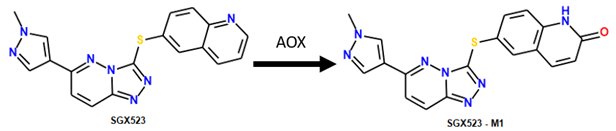
Aldehyde oxidase (AOX) is a cytosolic enzyme expressed in the liver and other organs of mammals. As the name implies, it is responsible for oxidizing aldehydes to convert them into carboxylic acids. It is a dimeric, molybdenum containing protein with a molecular weight of approximately 300 kDa composed of two identical subunits. It also oxidizes unsaturated carbon atoms next to a nitrogen in aza-aromatic rings. It is an enzyme of emerging importance in drug discovery because aza-aromatic rings are prevalent in kinase inhibitors. The figure below shows the AOX transformation of the quinoline ring in SGX523. The solubility of the metabolite is lower than that of the parent compound and the metabolite crystallized in the kidney for Phase I clinical trial patients who received an 80 mg dose, causing renal failure (Diamond 2010).
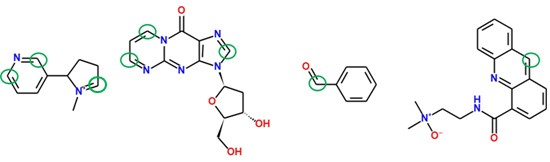
To be metabolized by AOX, compounds must bind but they must also bear a viable reactive hydrogen. A new descriptor, N_AOXSites, has been added to ADMET Predictor to identify input compounds that are potential AOX substrates. The atom types counted are:
-
The carbonyl carbon in aldehydes;
-
Ring carbons attached to one hydrogen and having a double or aromatic bond to a nitrogen;
-
Ring carbon atoms across from the nitrogen of an acridine that bear a hydrogen atom.
Some hydroxamic acids and amides are broken down by AOX (e.g., Sodhi 2015). The reaction in those cases is atypical, however, in that it is hydrolytic rather than oxidative, so they are not considered here. Qualified AOX oxidation sites which are highlighted by a green circle in the examples shown below.
A set of 522 molecules containing at least one potential oxidation site (Beedham 1995; Xu 2017; Cruciani 2018) was used to construct the AOX_Substr classification model built used to assess whether molecules that contain possible oxidation sites are likely to bind productively.
|
Model |
Set |
Negatives |
Positives |
Total |
Correct |
Concordance |
Sensitivity |
Specificity |
|---|---|---|---|---|---|---|---|---|
|
AOX_Substr |
Training |
248 |
201 |
449 |
392 |
87.3% |
86.1% |
88.3% |
|
Test |
38 |
35 |
73 |
59 |
80.8% |
82.8% |
78.9% |
The output prediction for AOX_Substr is NoSites when N_AOXSites = 0.
A second model (AOX_Sites) built using atomic descriptors is used to assess which of the potential sites in a bound molecule is most likely to be get oxidized. The data set consisted of atoms that are potential AOX sites of metabolism and the dependent variable indicated if the potential site was an observed site or not. Furthermore, the data set only included compounds that contained unambiguously assigned AOX oxidation sites. The performance statistics obtained are shown below: only six sites of metabolism in the training pool were misclassified and all sites were predicted correctly for the test set.
|
Model |
Set |
Negatives |
Positives |
Total |
Correct |
Concordance |
Sensitivity |
Specificity |
|---|---|---|---|---|---|---|---|---|
|
AOX_Sites |
Training |
56 |
134 |
190 |
182 |
95.8% |
97.8% |
91.1% |
|
Test |
10 |
20 |
30 |
30 |
100.0% |
100.0% |
100.0% |