

CYPs and AOX
Once a structure has been loaded into MedChem Designer, a metabolite map is generated by selecting the molecule and clicking on the 
The map will come up in a new window; the predictions for CHEMBL518996 are shown below for the default case where metabolites are generated for CYPs 2C9, 2C19, 2D6 and AOX; CYPs 1A2 and 3A4 were turned off to reduce clutter in the map and the compound is predicted to not be a substrate for 2C9 and 2C19. Its metabolic pattern illustrates the range of information that can be gained by analyzing such a map.
The total predicted CLint for the three CYP isoforms that are turned on is 4 μL/min/mg HLM protein, with comparable rates of attack (3 and 1 μL/min/mg HLM protein) on the pyridine methyl group (1) and on the piperidine N-methyl group (2), respectively. The aromatic hydroxymethyl metabolite M1 is stable, but the N-hydroxymethyl group in M2 is not: it will eliminate formaldehyde to produce M3. The absence of CYP labels on the secondary reaction arrow (3) indicates that the decomposition is spontaneous. Assuming that the respective decompositions go to completion, the predicted molar yields of M1 and M3 are approximately equal (58 and 42%, respectively).
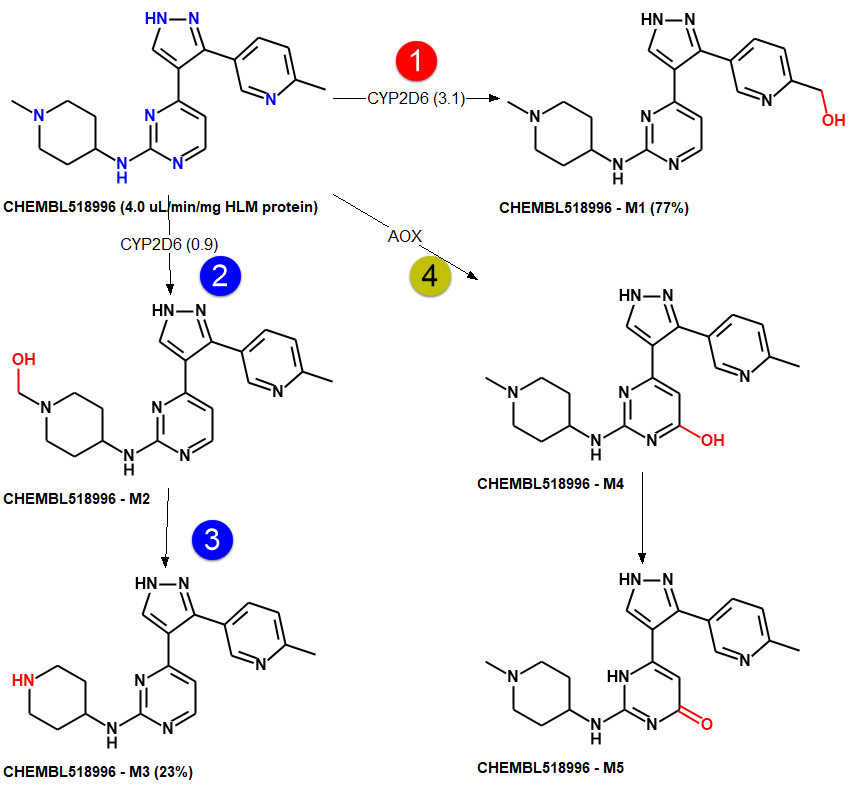
CHEMBL518996 is also predicted to be a substrate for aldehyde oxidase (AOX; (4)). The hydroxypyrimidine M4 that is formed initially by this oxidation is also unstable, and will tautomerize rapidly to pyrimidone M5. You can use the menu system to suppress display of unstable intermediates: select EDIT >> Change Settings, then go to the Metabolites tab in the dialog that pops up. Note that metastable intermediates (i.e., those that are Observable under some conditions) can be displayed even when transient ones are suppressed. You can also suppress display of metabolites that are only produced in low yields.
An additional metabolic iteration can be initiated by selecting an individual metabolite and repeating the process. Bear in mind that only one molecule at a time can be handled this way. Products of metabolic transformations that produce multiple fragments (e.g., dealkylation of esters and amines) must be separated using STRUCTURE >> Ungroup before proceeding.
Multiple compounds can be processed simultaneously through multiple cycles from the spreadsheet menu bar using DATA >> Predict Metabolites... >> CYP/AOX (1), which will generate a table of metabolites. You can accomplish the same thing by clicking on the
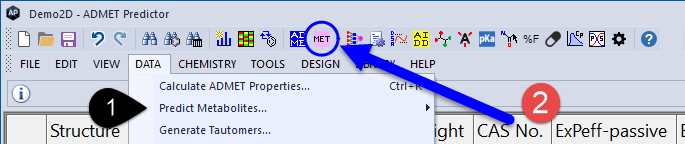
Any of these actions launches the Generate metabolites dialog, which provides you with multiple choices related to CYP enzymes and AOX.
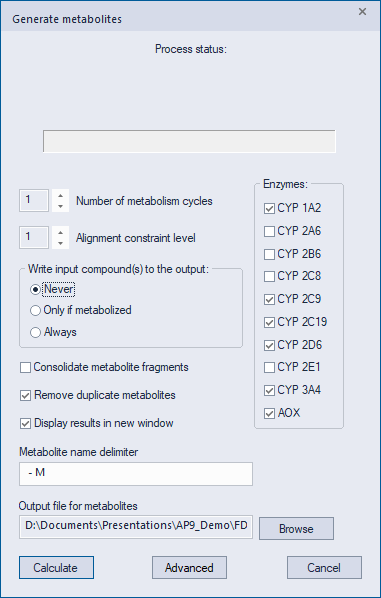
Dialog options include:
Number of metabolism cycles. One advantage of ADMET Predictor’s metabolite generation engine is that you can simulate multiple rounds of metabolism (to get secondary and tertiary metabolites, for example) in just a single step, and save those metabolites in an SD file.
Alignment constraint level controls the degree to which a generated metabolite is constrained to have the same 2D atomic coordinates as its parent molecule. A value of zero indicates no constraint, meaning that the atomic coordinates of each metabolite will be completely regenerated. Larger values lead to better alignments between metabolites and their parent molecules, but may cause overlapping atoms in some situations.
Write input compound(s) to the output controls whether substrates will be written to the output along with metabolites; the three options are Never, Only if metabolized and Always.
Consolidate metabolite fragments is relevant only in the situation where spontaneous decomposition of a metabolite splits it into two or more disconnected fragments. When this option is checked ON, those fragments are treated as a single, multifragment compound and are written to a single row in the metabolite spreadsheet. If the option is OFF, the fragments are displayed as distinct metabolites, each in its own row.
Remove duplicate metabolites. If multiple metabolism cycles result in identical metabolites, the duplicate metabolites of a single compound are removed.
Display results in new window launches a new ADMET Predictor window displaying all predicted metabolites along with which CYPs are involved.
Metabolite name delimiter controls the suffix used for metabolite naming. The default value of " -M" yields metabolite names ending with " - M1", " - M2", etc.
Predicted metabolites are generated in two steps. The first is to predict the likely sites of metabolic oxidation. These site predictions are based on models built on individual CYP isoforms (1A2, 2A6, 2B6, 2C8, 2C9, 2C19, 2D6, 2E1 and 3A4) or aldehyde oxidase (AOX). The second step is to predict the metabolites that would be generated for each atomic site from the first step. This process relies on a set of user-customizable chemical transformation rules included in ADMET Predictor.
The output file generated will contain the metabolites generated (and, if specified, the original compounds selected) as well as several special attributes:
-
Met_Level: 0 for input compounds, 1 for a primary metabolites, 2 for secondary metabolites, etc.
-
Met_CYPxxx: CLint for CYPxxx summed across all sites that lead to a primary metabolite
-
Met_PctYield: percentage of all metabolites represented by the metabolite
-
Met_Sum: sum of values from all Met_CYP columns; this value should be similar to CYPSum_CLint
-
Met_Enzymes: list of enzymes predicted to produce the metabolite
-
Met_MassList: observable atomic masses of the product; useful for mass spectral analysis
-
Met_Decomp_From: indicates that the metabolite is a product of non-CYP catalyzed decomposition from an observable intermediate; records the names of "ancestral" metabolites leading back to the original compound
-
Met_Alt_Route: lists alternative paths to the metabolite other than the one indicated in its name.
For additional information about the metabolite generation process, including a discussion of the underlying transform rules, please consult the manual for MedChem Designer, which also provides maps of predicted metabolites and their interrelationships.