

Gluronidation products are generated in MedChem Designer by selecting a single molecule, then UGT from the pull-down menu to the right of the 
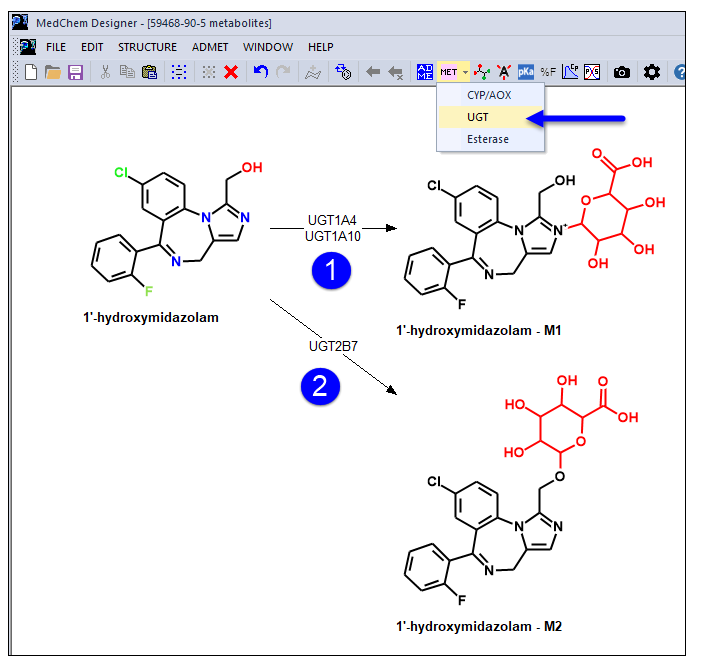
Both metabolites and their respective assignments to UGTs 1A4 and 2B7 are correct (Hyland 2009) but the classification as a substrate for UGT1A10 is a false positive.
The imidazolium metabolite M1 may look unlikely but it and other N+-heterocyclic glucuronides are real (Kaivosaari 2011) and important. They are fairly reactive, as are glucuronides of pyridines, tertiary amines and carboxylic acids. This makes the glucuronic acid moiety more or less easy to shift to another nucleophilic atom within such a metabolite or to a protein. In many cases, however, the glucuronide is stable enough to be transported from the liver into the bile, and to go from there back into the digestive tract. Once back in the gut, it breaks down to the parent compound spontaneously or enzymatically. Such a cycle is called enterohepatic circulation; it lowers the maximal plasma concentration but slows elimination, thereby enhancing overall bioavailability.
Glucuronidation of a carboxylic acid can also catalyze subsequent lactonization when a hydroxy group is present elsewhere in the same molecule, for example - a reaction that is particularly important for statins (Fujino 2004). This spontaneous secondary reaction is accommodated in ADMET Predictor by associating carboxylic acid transforms with a lactonization transform that is applied if a properly positioned hydroxy group is available.
Default behavior such as which UGTs are applied and how results are displayed, can be altered via the Metabolites tab in the Change settings dialog, which can be launched from the MedChem Designer toolbar by clicking on the sprocket icon or via the menu system: EDIT >> Change Settings...
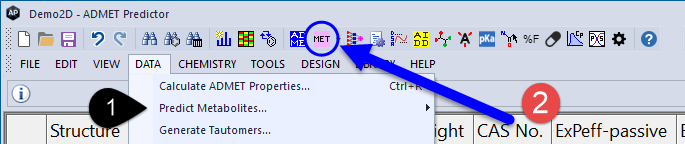
You can generate UGT metabolites for a selected set of structures in the spreadsheet by choosing the menu item DATA>>Predict Metabolites >> UGT (1), by selecting UGT from the drop-down menu to the right of the
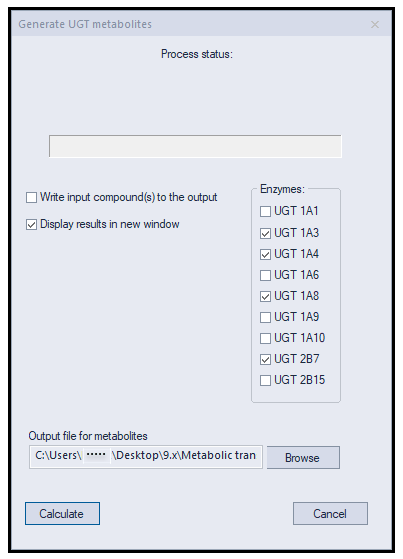
Doing either launches the Generate UGT metabolites dialog, which lets you choose which UGT models to run, whether to include the input molecules in the output file, whether or not to Display results in new window. and where the output file should go. All nine UGT models are turned ON by default. Internal studies showed that the four selected below (UGTs 1A3, 1A4, 1A8 and 2B7) account for 90% of the substrates and metabolites generated from reference sets of drugs and development compounds.
See the section on generating oxidative metabolites for details concerning the options.
Identifying Sites of Glucuronidation
UGTs glucuronidate multiple kinds of sites in their substrates, including aliphatic hydroxy groups, carboxylic acids, phenols, aliphatic amines, anilines and nitrogen atoms in aromatic heterocycles. Each isoform can attack multiple kinds of groups, but has a characteristic hierarchy of preferences. When multiple potential sites occur in a molecule predicted to be a substrate, only one is usually glucuronidated by each isoform, though which one that is can be different for different isoforms.
Several reviews (e.g., Sorich 2006; Kaivosaari 2011;[ Peng 2014]; Oda 2015; Rudik 2015) were consulted in formulating an initial set of more or less generic substructure queries and these were focused iteratively by running against the aggregated UGT substrate data set used to build our classification models. For each UGT, the initial transforms were ordered based on the order of glucuronidation activity across site classes reported by Tukey & Strassburg (2000). For each isoform for which a compound was predicted to be a substrate, the corresponding transforms were applied in order until one "hit." The rankings were further refined by running them on the aggregated UGT substrate data set, and the open literature.
The number of SMIRKS transforms for each UGT in the final glucuronide prediction tool ranged from 7 for UGT2B15 to 18 for UGT1A3. The tool's performance was evaluated by application to the 54 compounds in the test set used by Peng et al. (2014). Site of metabolism data from that test set were not been used in constructing the glucuronidation transforms, though 6 of them were in our substrate classification set.
Performance of our tool is compared below to Peng et al.'s own models as well as to more recent models from Cai et al. (2019), which they evaluated against the same test set.
|
Model Source |
ADMET Predictor |
Peng et al. |
Cai et al. (global) |
Cai et al. (local) |
|---|---|---|---|---|
|
Sensitivity |
0.853 |
0.838 |
0.657 |
0.826 |
|
Specificity |
0.850 |
0.900 |
0.824 |
0.817 |
|
Concordance |
0.851 |
0.872 |
0.758 |
0.820 |
|
Pos Predictive Value |
0.829 |
0.877 |
0.708 |
0.740 |
|
Neg Predictive Value |
0.850 |
0.867 |
0.788 |
0.881 |
These statistics underestimate the performance of our model and overestimate the performance of the one Peng et al. created. Their categorizations were based only on in vivo data, and we used them as published to calculate the statistics shown above. That is likely to miss labile acyl and some N+-glucuronides, which probably accounts for the fact that four known positives shared by the data sets had been labeled as having no glucuronidation sites by Peng et al. A similar phenomenon probably accounts for the nominally superior combined negative predictive value of Cai et al.'s four local models.
Our glucuronidation tool is more an expert system than a "model", which makes some of our standard validation measures hard to calculate. A good idea of its performance can, however, be obtained by looking at how often it fails to find a suitable glucuronidation site in known UGT substrates - i.e., its coverage. When combined with the UGT substrate models, the transforms failed to produce a glucuronide for 13 of 409 compounds classified as being a substrate by at least one UGT model. Of these, 9 compounds were not experimentally known substrates for any UGT - i.e., they were false positives. No metabolites were generated for four substrates (the structures labels are CAS numbers):
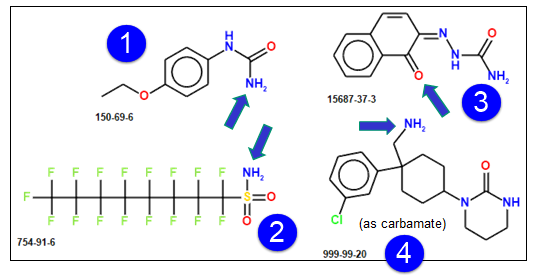
The urea (1) and fluorosulfonamide (2) are very unusual cases, as is noted in the literature. Hydrazone 3 is nominally glucuronidated at the carbonyl oxygen, which becomes a hydroxy group after tautomerization to a higher-energy form that is evidently stabilized by protein interactions in the UGT binding site. Compound 4 is not itself glucuronidated. Instead its primary amine reacts spontaneously with dissolved CO2. The (unstable) carbamic acid that forms is recognized as a substrate and, if input, gets trapped as the correct glucuronide:
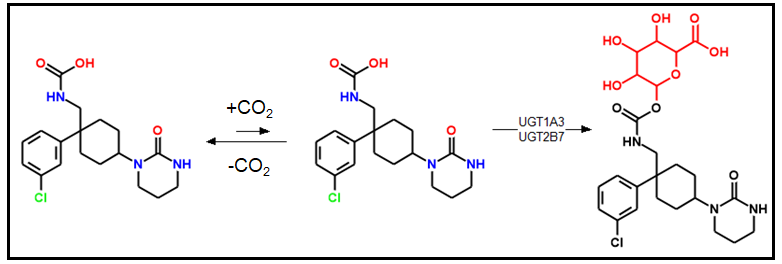
When applied to a 2270-compound reference subset drawn from the World Drug Index (WDI), one or more metabolites were generated for 1749 molecules flagged as likely substrates of at least one UGT. No putative metabolites were produced for 246 of them, which corresponds to a transform coverage of 88%. Most of these only contain sites that are rarely glucuronidated in humans.
O-Glucuronides were found for hydroxylated metabolites of some cases, consistent with unproductive binding of the parent drug. Taken together, these observations make it likely that the associated classifications as substrate(s) are false positives.
Caveats
It is always prudent to check for out-of-scope and low-confidence predictions when applying classification models, but this is particularly important for UGT models. Also bear in mind that glucuronides themselves "look" like UGT substrates because of the hydroxy groups and carboxylic acid groups that they bear. Polyglucuronidation does occur, but most monoglucuronides get transported out of the cell into the bile or the systemic circulation before any more glucuronosyl groups can be added.
The instability of some glucuronides, their susceptibility to rearrangement and challenges in assigning sites of metabolism unambiguously makes careful curation critical when trying to do an independent validation of predicted metabolites. In particular, apparent false positives should be considered as tentative for any such glucuronide.