

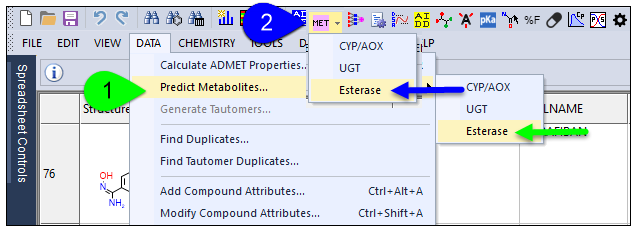
Enzymatic hydrolysis products are produced by various generic esterases distributed through the body - in the gut, in the systemic circulation and within most tissues, for example. Metabolites for individual molecules can be generated in ADMET Predictor and/or MedChem Designer by selecting a single molecule, then choosing Esterase from the pull-down menu to the right of the 
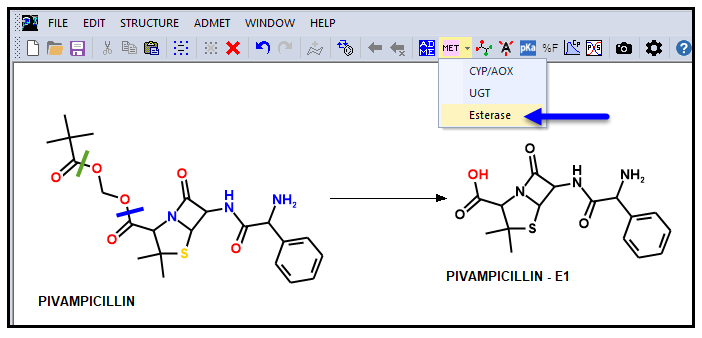
Removal of the diester masking group can take place by several different routes. Cleavage on the pivalate (tBuCOO) side (green) will release the hydroxymethyl ester of ampicillin, which will spontaneously decompose to formaldehyde and ampicillin if it isn't first hydrolyzed enzymatically (blue). Other esterases may hydrolyze the ampicillin ester first (blue), in which case the released hydroxymethyl pivalate will break down to pivalic acid and formaldehyde. Breakdown is likely to follow all of those routes and each will be followed more or less independently.
The overall reaction produces ampicillin, pivalic acid and formaldehyde. Pivalic acid and formaldehyde are recognized as being common components of prodrugs that are biologically inert at pharmaceutical doses, so they are discarded to simplify the scheme. The list of common esterase fragments is in your applications directory as a SMILES file - metaboliteFragments_Esterase.smi. It is not encrypted, so you can add or delete fragments if necessary.
The map is simpler than those for CYPs in other ways as well: no specific enzyme is indicated on the reaction arrow; no yield estimates are provided; and only one reaction is shown. These differences reflect the absence of specific models for individual esterases and of quantitative kinetic models, but it also reflects the fact that the sequence of reactions is not coordinated. Because of this, the transformations contained in the metabolitePrediction_Esterase.crf file in your applications directory are applied iteratively and exhaustively - i.e., until no further change is seen. This is very different behavior than the transforms used to generate UGT metabolites: there transformations are applied sequentially only until some change is seen for a given UGT for which a compound is predicted to be a substrate.
You can generate likely esterase metabolites for a selected set of structures by choosing the menu item DATA>>Predict Metabolites >> Esterase (1), by selecting Esterase from the pull-down menu to the right of the
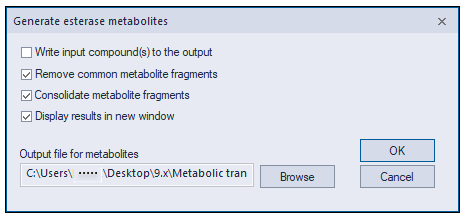
Doing either launches the Generate esterase metabolites dialog, which provides you with several options for exactly how to proceed. You can:
-
Choose whether or not to write your starting structures to the output file along with their metabolites. Molecules that produce no metabolites will not be transferred.
-
Control whether or not common metabolic fragments (e.g., ethanol, acetic acid, etc.) get removed automatically.
-
Whether each metabolite produced will get its own row in the output spreadsheet or whether they should be treated as a single compound composed of multiple molecular fragments. Note that turning this option OFF is likely to prevent you from being able to calculate ADMET properties without further manipulation .
-
Whether or not the output file of metabolites should open automatically in a new window.
Importance of Recognizing Prodrugs
A primary motivation for our developing a tool for predicting esterase activity was that the predictions obtained by inadvertently running prodrugs (e.g., antivirals) through ADMET Predictor were likely to be misleading or wrong, especially when it comes to pharmacokinetics. The reason is that ester prodrugs work precisely because the prodrug and its unmasked "warhead" have very different properties. Ampicillin is polar and depends on PepT1 for uptake in the gut, which can result in problems when a drug is taken with food. Prodrug esters like pivampicillin are not themselves antibacterial but exhibit increased passive permeability. That increases their uptake and the speed and extent of absorption (Ehrnebo 1979). It is rapidly cleaved once it reaches the portal vein, thereby unmasking the active principle to go about its antibiotic business.
Hence the pharmacokinetics of a prodrug reflect two different molecular structures: the properties of the ester control absorption but the properties of the unmasked, activated drug control distribution, subsequent metabolism and excretion. We advise running the esterase metabolism tool on all compounds before calculating ADMET properties so as to be forewarned of such complications.
Identifying Sites of Hydrolysis
The literature on substrate specificity and kinetics of individual esterases is too limited to support building useful models. Fortunately, there is one rule of thumb that are broadly applicable, namely that cleaved compounds must balance steric hindrance around the ester bond against having too little bulk for the enzyme to get a grip on. Methyl esters, for example, are usually cleaved by CYPs rather than esterases, whereas t-butyl esters are cleaved slowly if at all. Our esterase metabolite prediction tool was developed by refining such rules of thumb.
We started from a set of SMIRKS transformations built around examplary (thio)esters, carbamates, phosphates and phosphoramidates drawn from four reviews: Rautio et al (2018); Huttunen et al. (2011); Vacondio et al. (2010); and Beaumont et al. (2003). The initial queries were refined by running them run against our 2270-compound WDI reference set. This served as a reality check on their general ability to discriminate between prodrugs and other compounds. “Hits” at each stage were checked by web searches against the compound name along with keywords such as “prodrug”, “metabolite”, “metabolism” or “mode of action.”
In some cases lability was confirmed by indications that the hydrolysis product was active against the therapeutic target or that the compound itself was inactive. Hits for which the main route of metabolism was hydrolysis were categorized as "strong positives," whereas those for which hydrolysis was significant but not necessarily the main route of metabolism were categorized simply as positives.
In cases where the therapeutic target was not systemic (i.e., for gastrointestinal or ocular targets), susceptibility to enzymatic hydrolysis could not be determined from accessible sources; such hits were categorized as "unknown". Prodrugs hit by the transforms but definitely not hydrolyzed in vivo were categorized as negatives. Those were typically activated by CYP oxidation.
Most compounds (87%) were not "hit" by the final transform set at all, consistent with estimates of the percentage of drugs that can be classified as “prodrugs”, i.e., between 12 and 20% (Rautio 2018; Huttunen 2011).
|
Transformed? |
Strong Positives |
Positives |
Unknowns |
Negatievs |
No reaction |
|---|---|---|---|---|---|
|
YES |
190 |
18 |
17 |
3 |
0 |
|
NO |
8 |
3 |
5 |
44 |
1982 |
|
Statistics |
Class |
Value |
|---|---|---|
|
Sensitivity |
Strong Positives Only |
0.96 |
|
All Positives |
0.95 |
|
|
Specificity |
Negatives |
0.91 |
Applying the final esterase transforms to 267 non-cyclic carboxylate and phosphate esters from the World Drug Index (2008; 73.6 K entries) that contain the word “prodrug” in the Comments or Mode of action (MA) column yielded metabolites for 225 of them. That translates to a coverage of 84%, which rises to 89% when methyl esters (which usually cleaved oxidatively by CYPs) and esters of tertiary alcohols are excluded. The latter are sometimes used as a way to slowly release the active principle, usually a steroid. Unlike less hindered esters, their presence in a molecule is unlikely to cause problems with rapid metabolism.
Caveats
Methyl esters were assumed to not be esterase substrates, as were lactones. Enzymatic cleavage of the latter is rather idiosyncratic, e.g., those in statins and other paraoxonase substrates are an exception that is not accounted for.