

New models for bRo5 compounds – EPSA, ChromLogD, and ChamelogK
EPSA, ChamelogK, and ChromLogD are complementary experimental tools that provide key insights into the drug-likeness of beyond rule of five (bRo5) compounds, where traditional metrics often fall short. EPSA (sometimes called experimental, extended, or exposed polar surface area) is a supercritical fluid chromatography technique that quantifies the experimentally accessible polarity of a molecule, capturing conformational shielding effects that computational descriptors like TPSA cannot, thus helping to rationalize permeability in large or flexible molecules (Goetz et al 2014). ChamelogK represents the difference in measured log k′ (chromatographic capacity factors) of a compound under different mobile phase conditions (typically aqueous vs. more lipophilic). The magnitude of this shift quantifies a compound’s “chameleonicity”—its ability to change apparent polarity depending on the environment. A higher ChamelogK indicates stronger adaptive behavior, useful for bRo5 compounds that need to balance solubility with permeability (Garcia et al. 2023). ChromLogD replaces traditional shake flask derived LogD values as the traditional method can only provide accurate measurements to a LogD of ~4.5, and many bRo5 molecules have values >4.5 (Valkó et al. 1997 and Santisteban et al. 2024). Each of these has been used by various groups to assist with the development and prioritization of PROTACs and other bRo5 molecules. For instance, two papers from AstraZeneca show how they use EPSA and ChromLogD for internal PROTAC development, even leading them to develop a “Rule-of oral-PROTACs” that consists of eHBD (solvent exposed) ≤ 2, ePSA ≤ 170, eRotB ≤ 13, MW ≤ 1000, chromLogD ≤ 7 and eHBA ≤ 16 (Santisteban et al 2024 and Schade et al. 2024).
Being able to predict these values without having to experimentally determine them will aid in the design and prioritization of PROTACs and other bRo5 molecules; as such, we have built regression models for each of these endpoints. These models can also be used as descriptors when creating models to predict ADME properties of bRo5 molecules, especially permeability and solubility.
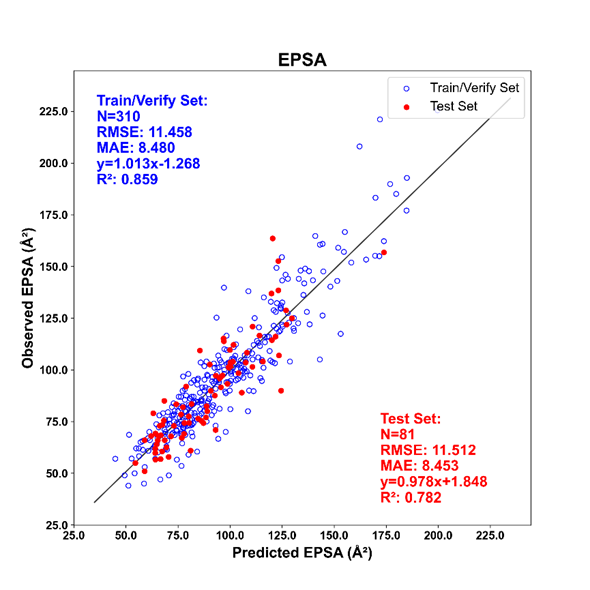
EPSA: Data was collected from nine studies, all performing chromatographic experiments with the exact same or very similar methodology. There was significant overlap among the compounds studied, all with a high degree of precision. For instances of multiple values for the same molecule, the median value was used, leaving a total of 391 values. There were 202 compounds that broke at least one rule of 5, including 24 cyclic peptides, 12 PROTACs, and 22 macrocycles. Like TPSA, EPSA is reported in square angstroms.
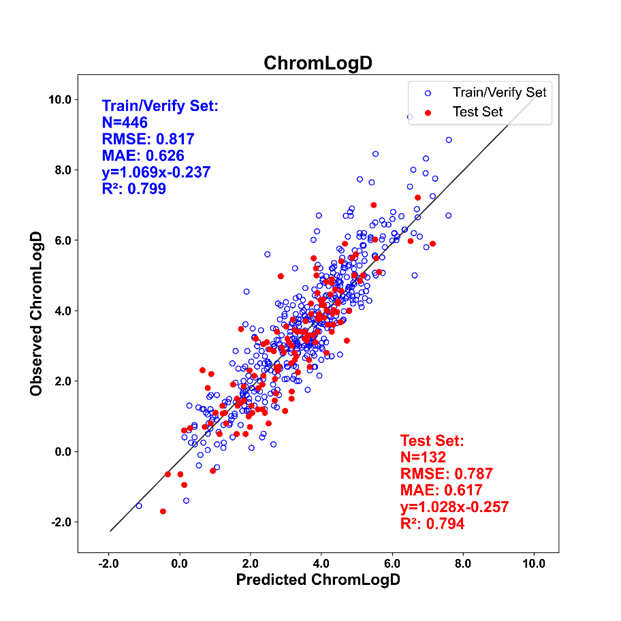
ChromLogD: Data was collected from 14 studies, all performing chromatographic experiments with the exact same or very similar methodology (all at pH 7.4). For instances of multiple values for the same molecule, the median value was used, leaving a total of 587 values. There were 276 compounds that broke at least one rule of 5, including 20 cyclic peptides, 27 PROTACs, and 75 macrocycles.
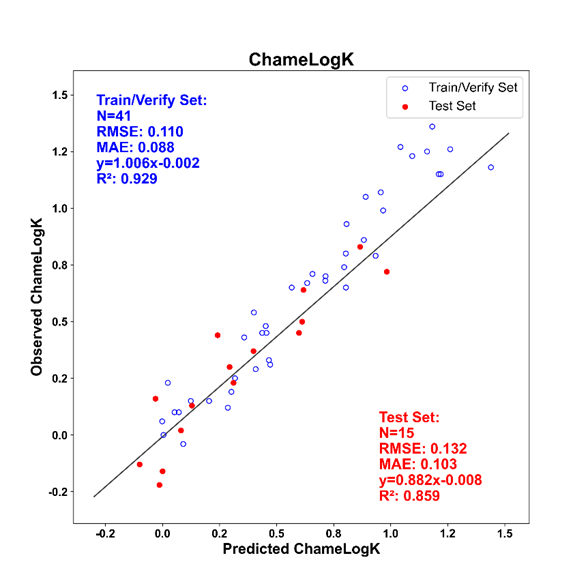
ChameLogK: Data was collected from Garcia-Jimenez et al, a total of 56 measurements. There were 35 compounds that broke at least one rule of 5, including 2 cyclic peptides, 19 PROTACs, and 5 macrocycles.
Beyond Rule of Five Filters
Three groups of compounds stand out among the bRo5 crowd: macrocycles, cyclic peptides, and PROTACs (PROteolysis TArgeting Chimeras). “I’ll know it when I see it” may work well for humans, but for a computer automated classification of a given compound into these groups (which may overlap) is not an easy task. For this reason, we have developed descriptors and predictive models listed below.
Macrocycles are the easiest to detect. Our new molecular descriptor named “Macrocycle” simply equals to 1 for compounds containing a ring with at least 12 atoms within its smallest ring set.
Cyclic Peptides are detected with the aid of our new CyclPept model. To build it we have combined World Drug Index and several public databases to arrive at a large set of 59,793 organic compounds of pharmaceutical significance. 6,925 of these were cyclic peptides. The positives thus represented only 11.6% of the entire data set. ADMET Modeler handles even heavily imbalanced data to build high quality binary classifications models. The CyclPept one performs superbly as illustrated by the table below:
|
Model |
Set |
Negatives |
Positives |
Total |
Correct |
Concordance |
Sensitivity |
Specificity |
|---|---|---|---|---|---|---|---|---|
|
CyclicPept |
Training |
47560 |
6253 |
53813 |
53804 |
100% |
100% |
100% |
|
Test |
5308 |
672 |
5980 |
5976 |
99.9% |
99.6% |
100% |
With only 9 false positives (FP) and 4 false negatives (FN) the model’s sensitivity is 99.9% and specificity 100%.
PROTACs were also included in the data set described above, counting 6,456 compounds. Once again, ADMET Modeler handled 90%-negative biased modeling set with ease yielding virtually ideal classification model named PROTAC:
|
Model |
Set |
Negatives |
Positives |
Total |
Correct |
Concordance |
Sensitivity |
Specificity |
|---|---|---|---|---|---|---|---|---|
|
PROTAC |
Training |
48015 |
5798 |
53813 |
53811 |
100% |
100% |
100% |
|
Test |
5322 |
658 |
5980 |
5978 |
100% |
100% |
100% |
Almost 100% sensitivity and 100% specificity was guaranteed by misclassification of only 4 false positives (FP, two of these compounds overlap in the above chart).
Are the two classification models overtrained? No, in each case good modeling practices were followed to the letter, early stopping and external test sets among them, to prevent overtraining. Skeptics may be convinced by the fact that in both cases the endpoints were structural features modeled with structural descriptors.