

4.2.3. Class Generation Methods
Automated class generation is generally performed in two steps.
-
The first step involves searching the full set of molecules for all unique structural fragments that are present. The type of structure identified depends on the chosen class generation method: for example, in the Ring-anchored systems method (see below), the fragments are comprised of single, fused and connected rings. The size of the data set, along with any user-specified parameters, will determine how many fragments are identified during this process.
-
The second step is to form classes using the list of identified structures. Each fragment identified in the first step will be considered as a potential new class, the members of which would include each molecule having the particular fragment as part of its molecular structure.
The final set of classes will be a subset of this full collection, chosen to provide an adequate representation of the molecules, a minimal number of singletons (unclassified molecules) and an acceptable level of overlap between classes.
When you specify automated class generation, by selecting the Generate option from the CLASSES menu, the result is to display the Generate classes dialog.
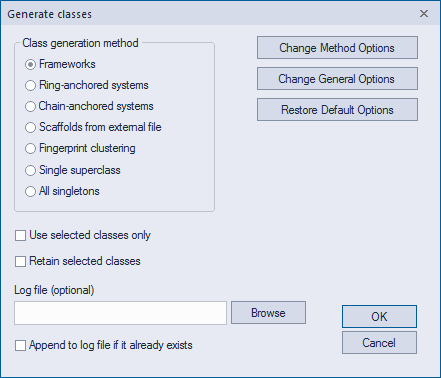
The first section of the dialog allows you to specify a particular class generation method, several of which are outlined below. Once a particular method has been selected on the dialog, you can adjust the method parameters by clicking either of two buttons, one labeled Change Method Options and one labeled Change General Options. The first adjusts the parameters related to the set of structural fragments (potential scaffolds) that underlie the chosen method of class generation. The second adjusts parameters related to the selection of those fragments to form classes; example parameters include homogeneity and redundancy.
Contents of this section:
Class generation using Frameworks
Class generation using Ring-anchored systems
Class generation using Chain-anchored systems
Class generation using Scaffolds
Class generation using fingerprint
Class generation using Single superclass