

Homogeneity and Redundancy
Two user-defined parameters, referred to as Homogeneity and Redundancy levels, are used to control how the generated fragments are used to create new classes. These options are available on the Class generation options dialog, which is displayed when you click on the Change General Options button on the Generate Classes dialog.
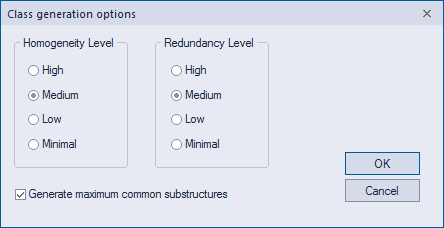
Homogeneity Level is a measure of the size of the common scaffold for a class relative to the size of the largest molecule in the class. Available settings for this value are High, Medium, Low and Minimal. High homogeneity means that the above ratio is required to be relatively large, implying that no members of a class can be significantly larger than the common scaffold. Low homogeneity means that the above ratio can be smaller, implying that one or more class members can be significantly larger than the common scaffold. Although a precise quantitative definition of homogeneity is beyond the scope of this guide, an approximate rule of thumb is that as the homogeneity setting decreases from High to Minimal (four settings total), the atom count of the common scaffold divided by the atom count of the largest molecule must be greater than values of 0.5, 0.4, 0.3 and 0.2, respectively.
The homogeneity setting can have a significant impact on the number and character of the generated classes. At higher settings, large molecules are excluded from particular classes by virtue of being too large relative to the class scaffold. These excluded molecules therefore become singletons unless they fall into a different class characterized by an appropriately sized scaffold. For this reason, high homogeneity settings tend to produce a larger number of classes, each characterized by a high degree of structural similarity among the member molecules. This effect is generally accompanied by an increase in the number of singletons. Conversely, low homogeneity settings tend to produce a smaller number of classes, fewer singletons and more structural diversity within each class.
Redundancy Level is a measure of the similarity in molecule membership between any two classes, and arises by virtue of the fact that a given molecule can belong to more than one class. High redundancy means that two classes can have nearly identical molecule members. Low redundancy means that the molecule members of every pair of classes must be substantially different. Thus as the redundancy setting increases, the number of classes into which a molecule is placed will generally increase. Although a precise quantitative definition of redundancy is beyond the scope of this guide, an approximate rule of thumb is that at a redundancy setting of High, most molecules will fall into more than one class; at Medium setting, roughly half of the molecules; at Low setting, roughly a quarter of the molecules; and at Minimal setting, almost none of the molecules.
It is important to note that the effect of decreasing the redundancy setting to Low or Minimal is generally to increase the number of singletons. This is because in attempting to satisfy the requirement of low redundancy, ADMET Predictor must exclude certain candidate classes from being part of the final solution, since they are too similar to classes already selected. But if these excluded classes contain molecules that are not contained in any other class, the molecules must necessarily become singletons. One way to minimize the impact of excess singletons is simply to re-generate classes using only the singleton molecules obtained from the original classification; you can do this by selecting the relevant singleton classes, then using CLASSES>> Generate and turning the Use Selected classes only option ON in the Generate classes dialog.