

Ring-Anchored Systems
The definition of ring system includes all single and fused rings, as well as groups of these connected by non-ring linker atoms. The simplest example would be either a single ring (e.g., benzene) or a single fused system (e.g., naphthalene). A more complex case would be these same two example systems (benzene and naphthalene) connected together by a chain of carbon atoms. You can place lower and upper bounds on the number of individual rings allowed in a ring system.
To generate classes based on Ring-Anchored Systems, use the CLASSES>>Generate menu item and select the Ring-anchored systems dialog option. Then click on the Change Method Options button to display a secondary dialog for method-specific options and parameters.
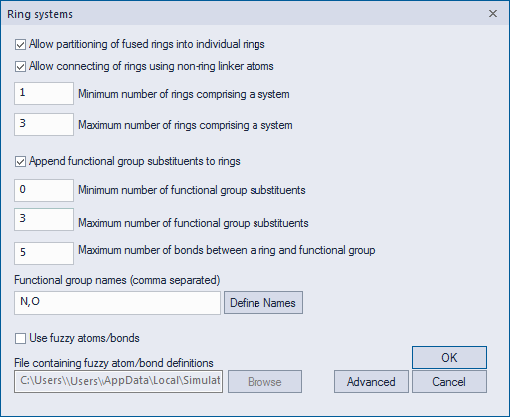
Please see the dialog tooltips for an explanation of each option or parameter.
Several dialog options are related to functional groups, which are user-defined substituents that can extend each ring-system fragment. Each functional group substituent consists of a chain of atoms starting at a ring and terminating at a group of atoms comprising the functional group; an additional requirement is that none of the atoms and bonds between the ring and the functional group can belong to a ring. Users are responsible for providing functional group definitions unless the default groups are accepted. Any user-defined functional groups must be specified as named-property queries in an SD or CQF file; sample files named functionalGroups.cqf and functionalGroups.sd are provided with the ADMET Predictor distribution to illustrate the definition process. The following functional group definitions are taken from the default file functionalGroups.cqf
# 1. Aliphatic Nitrogen
NAMEQUERY N
slq N
$$$$
# 2. Aliphatic Oxygen
NAMEQUERY O
slq O
$$$$
# 3. Amide group
#NAMEQUERY Amide
#slq NC=O
#$$$$
# 4. Acid group
#NAMEQUERY Acid
#slq OC=O
#$$$$
This example lists four distinct functional groups, though the last two have been “commented out” using the ‘#’ character, so will not have any effect within ADMET Predictor. As described in the file, each functional group is defined using a query string that conforms to the named-property query format described in the Query Formats section of this manual.
The following diagram illustrates how ring system fragments are generated for a single sample molecule. This example assumes that a single functional group has been defined consisting of oxygen atoms and that a minimum of two rings is required in each final fragment.
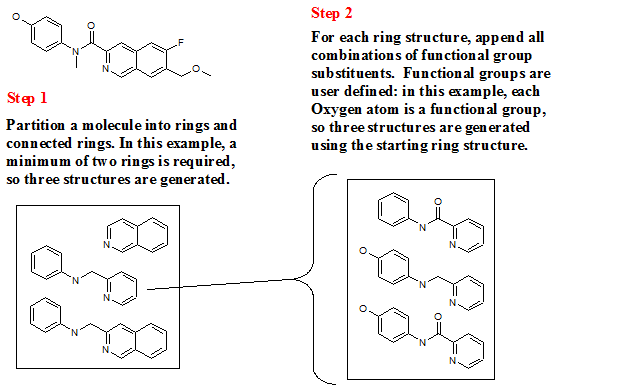
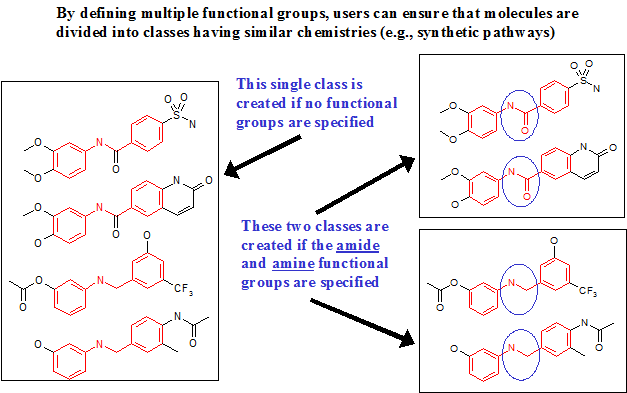
The following diagram provides a second example, illustrating how you can define functional groups to partition molecules by specific chemistries:
The Advanced button on the dialog provides additional options and parameters. One such parameter is an upper bound on the number of ring-connected fragments (RCFs) in each generated fragment. An RCF is essentially a fused ring system, but also includes isolated rings (rings not fused to any other ring). Two additional options are whether to allow fragments in which rings are connected by chain atoms and in which RCFs are broken up into individual rings.